Question:medium
Derive the expression for the magnetic field (near its centre) due to an air-filled long solenoid carrying a current $I$ and having $n$ number of turns per unit length.
Derive the expression for the magnetic field (near its centre) due to an air-filled long solenoid carrying a current $I$ and having $n$ number of turns per unit length.
Show Hint
Apply Ampere's law to a rectangular loop with one side inside the solenoid. The enclosed current is nLI, which gives B = mu0 n I.
Updated On: Oct 21, 2026
Show Solution
Solution and Explanation
Step 1: Picture the solenoid as stacked loops:
A long solenoid is a series of closely packed circular loops. Inside, the fields of neighbouring turns add up along the axis. Between adjacent turns on the outside, the fields cancel. So for a very long coil $B_{outside} \approx 0$.
Step 2: Draw the Amperian rectangle:
Take rectangle PQRS with PQ of length $h$ placed inside the coil, parallel to the axis. RS lies outside the solenoid. QR and SP are perpendicular to the axis.
Step 3: Split the circulation into four parts:
\[ \oint \vec{B}\cdot d\vec{l} = \int_P^Q + \int_Q^R + \int_R^S + \int_S^P \]
Only $\int_P^Q$ is non-zero and equals $Bh$. The part along RS vanishes because the outside field is zero. The parts along QR and SP vanish because $\vec{B} \perp d\vec{l}$ inside and $\vec{B} = 0$ outside.
Step 4: Count the current through the rectangle:
The number of turns that pass through the rectangle is $n h$. Each turn carries $I$, so the net current linked is $nhI$.
Step 5: Equate:
\[ Bh = \mu_0 (nhI) \Rightarrow B = \mu_0 n I \]
The length $h$ cancels, which also shows that the field does not depend on where the loop is placed inside the coil, so the field is uniform.
Final Answer:
The magnetic field inside a long air-filled solenoid is: \[ \boxed{B = \mu_0 n I} \]
Was this answer helpful?
0
Top Questions on Solenoids and Toroids
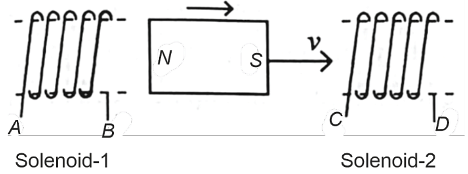
In the above diagram, a strong bar magnet is moving towards solenoid-2 from solenoid-1. The direction of induced current in solenoid-1 and that in solenoid-2, respectively, are through the directions :- NEET (UG) - 2024
- Physics
- Solenoids and Toroids
- The magnitude of magnetic field inside a solenoid of length 0.3 m having 800 turns carrying a current of 6 A is
- CUET (UG) - 2025
- Physics
- Solenoids and Toroids
- Want to practice more? Try solving extra ecology questions todayView All Questions