The magnitude of magnetic field inside a solenoid of length 0.3 m having 800 turns carrying a current of 6 A is
Show Hint
- 2.03 T
- 60.3 mT
- 20 mT
- 6.03 T
The Correct Option is C
Solution and Explanation
Step 1: Concept Overview:
A solenoid, essentially a coiled wire, generates a consistent magnetic field within its core when current flows through it. The field's intensity is determined by its turn density, the applied current, and the medium's magnetic properties.
Step 2: Governing Equation:
The magnetic field strength \(B\) inside a long solenoid is quantified by:\[ B = \mu_0 n I \]Here, \(\mu_0\) denotes the magnetic permeability of vacuum (\(4\pi \times 10^{-7} \, \text{T}\cdot\text{m/A}\)), \(I\) is the current magnitude, and \(n\) represents the number of turns per unit length. The term \(n\) is derived from \(n = \frac{N}{L}\), where \(N\) is the total number of turns and \(L\) is the solenoid's length.
Step 3: Calculation Breakdown:
Input Parameters:
Solenoid length, \(L = 0.3 \, \text{m}\).
Total turns, \(N = 800\).
Current, \(I = 6 \, \text{A}\).
Computation:
Calculate turns per unit length:
\[ n = \frac{N}{L} = \frac{800}{0.3} = \frac{8000}{3} \, \text{turns/m} \]Incorporate these values into the magnetic field equation:
\[ B = \mu_0 n I = (4\pi \times 10^{-7}) \times \left(\frac{8000}{3}\right) \times 6 \]\[ B = (4\pi \times 10^{-7}) \times (16000) \]\[ B = 64000 \pi \times 10^{-7} = 6.4\pi \times 10^{-3} \, \text{T} \]Approximate the numerical value using \(\pi \approx 3.14159\):
\[ B \approx 6.4 \times 3.14159 \times 10^{-3} \, \text{T} \]\[ B \approx 20.106 \times 10^{-3} \, \text{T} \]This is equivalent to 20.106 mT. The nearest option is 20 mT.
Step 4: Conclusion:
The magnetic field strength within the solenoid is approximately 20 mT.
Top Questions on Solenoids and Toroids
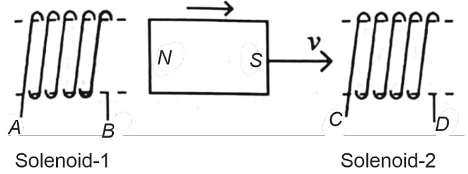
In the above diagram, a strong bar magnet is moving towards solenoid-2 from solenoid-1. The direction of induced current in solenoid-1 and that in solenoid-2, respectively, are through the directions :- NEET (UG) - 2024
- Physics
- Solenoids and Toroids
- Want to practice more? Try solving extra ecology questions todayView All Questions