Question:medium
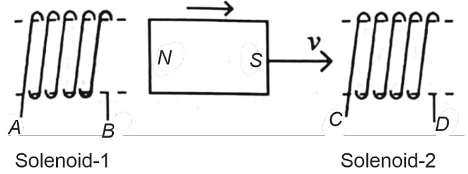
In the above diagram, a strong bar magnet is moving towards solenoid-2 from solenoid-1. The direction of induced current in solenoid-1 and that in solenoid-2, respectively, are through the directions :
In the above diagram, a strong bar magnet is moving towards solenoid-2 from solenoid-1. The direction of induced current in solenoid-1 and that in solenoid-2, respectively, are through the directions :
Updated On: Sep 10, 2026
- AB and DC
- BA and CD
- AB and CD
- BA and DC
Show Solution
The Correct Option is A
Solution and Explanation
When a strong bar magnet approaches a solenoid, an electromotive force (EMF) is induced in the solenoid via electromagnetic induction. Lenz's Law dictates the direction of this induced current: it opposes the change in magnetic flux causing it. We will analyze this process in stages:
- As the bar magnet nears solenoid-1, the magnetic flux through it increases. To counteract this increase, the induced current in solenoid-1 will generate a magnetic field opposing the approaching magnet's field.
- Applying the right-hand rule, if the north pole of the bar magnet moves towards solenoid-1, the induced current will flow in the direction AB. This establishes an induced magnetic field with its north pole directed at the approaching bar magnet.
- Next, consider solenoid-2. As the bar magnet moves away from solenoid-1 and towards solenoid-2, the magnetic flux through solenoid-2 increases. Consequently, the induced current in solenoid-2 will flow in a direction that opposes the incoming magnetic field.
- Again, using Lenz's Law and the right-hand rule for solenoid-2, the induced current will flow in direction DC. This creates an induced magnetic field with its south pole facing the bar magnet.
Consequently, the correct selection is AB and DC, indicating the induced current directions in solenoid-1 and solenoid-2, respectively.
Was this answer helpful?
6

