Question:medium
Derive an expression for refractive index of an equilateral prism in terms of the angle of minimum deviation and the angle of the prism. Plot a graph to show the variation of the angle of deviation as a function of angle of incidence.
Derive an expression for refractive index of an equilateral prism in terms of the angle of minimum deviation and the angle of the prism. Plot a graph to show the variation of the angle of deviation as a function of angle of incidence.
Show Hint
Use r1 + r2 = A and D = i + e - A. At minimum deviation i = e and r = A/2, so n = sin((A + Dm)/2) / sin(A/2). The D-i graph is a U-shaped curve.
Updated On: Oct 21, 2026
Show Solution
Solution and Explanation
Step 1: Name the angles:
Let the prism angle be $A$. A ray meets the first face at angle of incidence $i$ and refracts at angle $r_1$. At the second face the ray makes angle $r_2$ inside the glass and leaves at angle $e$ in air. The incident ray and the emergent ray make the angle of deviation $D$. Draw the prism, the normals at both faces and the three ray segments with these labels.
Step 2: Find the link between $A$, $r_1$ and $r_2$:
The two normals meet at a point N inside the prism. In the quadrilateral formed by the vertex A, Q, N and R, the angles at Q and R are $90^{\circ}$ each, so the angle at N is $180^{\circ} - A$. In triangle QNR the angles add up to $180^{\circ}$:
\[ r_1 + r_2 + (180^{\circ} - A) = 180^{\circ} \Rightarrow r_1 + r_2 = A \]
Step 3: Find $D$:
The ray is turned by $(i - r_1)$ at the first face and by $(e - r_2)$ at the second face. These turns are in the same direction, so they add:
\[ D = (i - r_1) + (e - r_2) = i + e - A \]
Step 4: Use the symmetric path:
At the minimum deviation the path inside the prism is parallel to the base, so $i = e$ and $r_1 = r_2$. Then $2r = A$ and $D_m = 2i - A$. So:
\[ r = \frac{A}{2}, \qquad i = \frac{A + D_m}{2} \]
Step 5: Put into the refractive index:
The index is the ratio of $\sin i$ to $\sin r$ (air to glass).
\[ n = \frac{\sin\frac{A + D_m}{2}}{\sin\frac{A}{2}} \]
For $A = 60^{\circ}$ this simplifies to $n = 2\sin\frac{60^{\circ} + D_m}{2}$.
Step 6: The D-i graph:
Plot $D$ against $i$. The graph has a single minimum at $D = D_m$, where $i = e$. On the left the curve rises steeply as $i$ gets smaller (towards the grazing emergence). On the right it rises as $i$ gets bigger. The shape is like a shallow parabola opening upwards.
Final Answer:
For the equilateral prism: \[ \boxed{n = 2\sin\left(\frac{60^{\circ} + D_m}{2}\right)} \]
Was this answer helpful?
0
Top Questions on Refraction Through A Prism
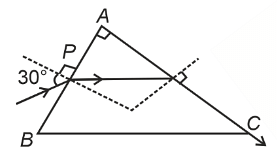
- A light ray enters through a right angled prism at point P with the angle of incidence 30° as shown in figure. It travels through the prism parallel to its base BC and emerges along the face AC. The refractive index of the prism is :
- NEET (UG) - 2024
- Physics
- Refraction Through A Prism
- A laser beam of wavelength 500 nm and power 5 mW strikes normally on a perfectly reflecting surface of area 1 mm\(^2\) of a body. It rebounds back from the surface. Find the force exerted by the laser beam on the body.
- CBSE Class XII - 2025
- Physics
- Refraction Through A Prism
- A ray of light is incident on face AB of a prism ABC with angle of prism \( A \) and emerges out from face AC. The prism is set in the position of minimum deviation with angle of deviation \( \delta \). Find (i) the angle of incidence and (ii) the angle of refraction on face AB.
- CBSE Class XII - 2025
- Physics
- Refraction Through A Prism
- Find the angle of deviation produced by the prism.
- CBSE Class XII - 2025
- Physics
- Refraction Through A Prism
- Want to practice more? Try solving extra ecology questions todayView All Questions