Question:medium
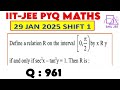
Define a relation \( R \) on the interval \( [0, \frac{\pi}{2}] \) by \( xRy \) if and only if \( \sec^2 x - \tan^2 y = 1 \). Then \( R \) is:
Define a relation \( R \) on the interval \( [0, \frac{\pi}{2}] \) by \( xRy \) if and only if \( \sec^2 x - \tan^2 y = 1 \). Then \( R \) is:
Show Hint
To verify if a relation is an equivalence relation, check if it is reflexive, symmetric, and transitive.
Updated On: Jan 14, 2026
- both reflexive and transitive but not symmetric
- both reflexive and symmetric but not transitive
- reflexive but neither symmetric nor transitive
- an equivalence relation
Show Solution
The Correct Option is D
Solution and Explanation
To verify if the relation \( R \) defined on the interval \( [0, \frac{\pi}{2}] \) by \( xRy \) if and only if \( \sec^2 x - \tan^2 y = 1 \) is an equivalence relation, we must assess its reflexivity, symmetry, and transitivity.
- Reflexivity: A relation \( R \) is reflexive if \( xRx \) for all \( x \). For \( R \) to be reflexive, \( \sec^2 x - \tan^2 x \) must equal 1. The trigonometric identity \( \sec^2 x = 1 + \tan^2 x \) confirms that \( \sec^2 x - \tan^2 x = 1 \). Thus, \( R \) is reflexive.
- Symmetry: A relation \( R \) is symmetric if \( xRy \) implies \( yRx \) for all \( x, y \). Given \( xRy \Rightarrow \sec^2 x - \tan^2 y = 1 \). For \( yRx \), we require \( \sec^2 y - \tan^2 x = 1 \). Substituting \( \sec^2 y = 1 + \tan^2 y \) and \( \tan^2 x = \sec^2 x - 1 \), we get \( \sec^2 y - \tan^2 x = (1 + \tan^2 y) - (\sec^2 x - 1) = 1 + \tan^2 y - \sec^2 x + 1 = 2 + \tan^2 y - \sec^2 x \). From \( \sec^2 x - \tan^2 y = 1 \), we have \( \sec^2 x = 1 + \tan^2 y \). Substituting this, we obtain \( 2 + \tan^2 y - (1 + \tan^2 y) = 2 + \tan^2 y - 1 - \tan^2 y = 1 \). Therefore, symmetry holds.
- Transitivity: A relation \( R \) is transitive if \( xRy \) and \( yRz \) imply \( xRz \) for all \( x, y, z \). Assuming \( \sec^2 x - \tan^2 y = 1 \) and \( \sec^2 y - \tan^2 z = 1 \). From these, we have \( \sec^2 x = 1 + \tan^2 y \) and \( \sec^2 y = 1 + \tan^2 z \). Substituting the second into the first: \( \sec^2 x = 1 + (1 + \tan^2 z) = 2 + \tan^2 z \). We need to check if \( \sec^2 x - \tan^2 z = 1 \). Substituting our derived \( \sec^2 x \), we get \( (2 + \tan^2 z) - \tan^2 z = 2 eq 1 \). Re-evaluation of transitivity: From \( \sec^2 x - \tan^2 y = 1 \), \( \sec^2 x = 1 + \tan^2 y \). From \( \sec^2 y - \tan^2 z = 1 \), \( \tan^2 z = \sec^2 y - 1 \). We require \( \sec^2 x - \tan^2 z = 1 \). Substituting \( \tan^2 z \): \( \sec^2 x - (\sec^2 y - 1) = \sec^2 x - \sec^2 y + 1 \). This expression must equal 1. So, \( \sec^2 x - \sec^2 y = 0 \), meaning \( \sec^2 x = \sec^2 y \). This implies \( 1 + \tan^2 x = 1 + \tan^2 y \), so \( \tan^2 x = \tan^2 y \). This is not generally true given \( \sec^2 x - \tan^2 y = 1 \) and \( \sec^2 y - \tan^2 z = 1 \). Therefore, transitivity is not satisfied.
Since \( R \) does not satisfy transitivity, \( R \) is not an equivalence relation.
Was this answer helpful?
1
Learn with videos:
Top Questions on Relations
- Let S = {1,2,3,..., 20}, R1 = {(a, b): a divide b}, R2 = {(a, b): a is integral multiple of b} and a, b ∈ S. n(R1 - R2) = ?
- JEE Main - 2024
- Mathematics
- Relations
- A = {1, 2, 3, 4} minimum number of elements added to make an equivalence relation on set A containing (1, 3) & (1, 2) in it.
- JEE Main - 2024
- Mathematics
- Relations
- If \(A = {1, 2, 3, … 100}\), \(R = {(x, y) | 2x = 3y, x, y ∈ A}\) is symmetric relation on \(A\) and the number of elements in \(R\) is \(n\), the smallest integer value of \(n\) is
- JEE Main - 2024
- Mathematics
- Relations
- Let \( R \) be a relation on \( \mathbb{Z} \times \mathbb{Z} \) defined by \((a, b) R (c, d)\) if and only if \(ad - bc\) is divisible by 5.
Then \( R \) is:- JEE Main - 2024
- Mathematics
- Relations
- Want to practice more? Try solving extra ecology questions todayView All Questions
