There are only three female students - Amala, Koli and Rini - and only three male students - Biman, Mathew and Shyamal - in a course. The course has two evaluation components, a project and a test. The aggregate score in the course is a weighted average of the two components, with the weights being positive and adding to 1 .
The projects are done in groups of two, with each group consisting of a female and a male student. Both the group members obtain the same score in the project.
The following additional facts are known about the scores in the project and the test.
1. The minimum, maximum and the average of both project and test scores were identical – 40, 80 and 60 , respectively.
2. The test scores of the students were all multiples of 10 ; four of them were distinct and the remaining two were equal to the average test scores.
3. Amala's score in the project was double that of Koli in the same, but Koli scored 20 more than Amala in the test. Yet Amala had the highest aggregate score.
4. Shyamal scored the second highest in the test. He scored two more than Koli, but two less than Amala in the aggregate.
5. Biman scored the second lowest in the test and the lowest in the aggregate.
6. Mathew scored more than Rini in the project, but less than her in the test.
What was Rini's score in the project?
Solution and Explanation
Given:
- 3 female students: Amala, Koli, Rini
- 3 male students: Biman, Mathew, Shyamal
- Total score is a weighted average: project weight = \( x \), test weight = \( 1 - x \)
- Projects are completed in male-female pairs; scores are shared: 40, 60, 80
- Test scores are multiples of 10; min = 40, max = 80, average = 60; 4 distinct scores, 2 are 60
From the problem statement:
- Amala's project score is twice Koli's. This implies Amala: 80, Koli: 40, Rini: 60.
- Koli scored 20 more than Amala on the test.
- Shyamal is second highest in test, scored 2 more than Koli and 2 less than Amala’s aggregate.
- Amala has the highest aggregate score.
Possible test scores: 40, 50, 60 (x2), 70, 80
Scenario 1: Amala test = 40, Koli = 60, Shyamal = 70
Aggregates:
- Amala: \( 40(1 - x) + 80x \)
- Koli: \( 60(1 - x) + 40x \)
- Condition: Amala = Koli + 4 →
\[ 40(1 - x) + 80x = 60(1 - x) + 40x + 4 \\ \Rightarrow 60x = 24 \Rightarrow x = 0.4 \] Amala's Aggregate: \( 40(0.6) + 80(0.4) = 24 + 32 = 56 \)
Shyamal's Aggregate (minimum): \( 70(0.6) + 40(0.4) = 42 + 16 = 58 \)
Contradiction: Shyamal's aggregate (58)>Amala's aggregate (56) → Scenario 1 is invalid.
Scenario 2: Amala test = 60, Koli = 80, Shyamal = 70
- Amala: \( 60(1 - x) + 80x \)
- Koli: \( 80(1 - x) + 40x \)
\[ 60(1 - x) + 80x = 80(1 - x) + 40x + 4 \\ \Rightarrow 60 + 20x = 84 - 40x \Rightarrow 60x = 24 \Rightarrow x = 0.4 \]
Amala's aggregate: \( 60(0.6) + 80(0.4) = 36 + 32 = 68 \)
Shyamal's aggregate: 66. Project score calculation: \[ \frac{66 - 70 \times 0.6}{0.4} = \frac{66 - 42}{0.4} = \frac{24}{0.4} = 60 \]
Further deductions:
- Biman: test = 50, project = 40 (lowest total)
- Mathew's project score>Rini's → Mathew = 80, Rini = 60
- Rini's test score>Mathew's → Rini = 60, Mathew = 40
Final Table:
| Student | Test Score (T) | Project Score (P) | Aggregate (0.6×T + 0.4×P) | Project Pair |
|---|---|---|---|---|
| Amala | 60 | 80 | 68 | Amala, Mathew |
| Koli | 80 | 40 | 64 | Koli, Biman |
| Rini | 60 | 60 | 60 | Rini, Shyamal |
| Biman | 50 | 40 | 46 | Biman, Koli |
| Mathew | 40 | 80 | 56 | Mathew, Amala |
| Shyamal | 70 | 60 | 66 | Shyamal, Rini |
Answer: Rini's project score is 60.
What was the weight of the test component?
- 0.60
- 0.75
- 0.40
- 0.50
The Correct Option is A
Solution and Explanation
To determine the weight of the test component, follow these steps based on the provided information:
1. Let \( w_p \) represent the project weight and \( w_t \) represent the test weight. The sum of these weights is 1:
\[ w_p + w_t = 1 \]
2. Amala's project score is double Koli's. Koli's test score is 20 points higher than Amala's. Amala has the highest aggregate score. This indicates the test component carries significant weight.
3. Shyamal's test score is 2 points higher than Koli's. Since Shyamal ranks second in the test, Amala must be the highest scorer in the test. Amala's highest aggregate score, despite potentially lower test scores than others, suggests the test component has considerable weight.
4. Amala's aggregate score is 2 points higher than Shyamal's. This implies the test score is heavily weighted to maintain Amala's top aggregate position, even if her test score is not the highest.
5. Given test scores range from 40 to 80, with an average of 60, we infer the following test scores:
\[ \text{Amala's test score} = 80,\quad \text{Koli's} = 60,\quad \text{Shyamal's} = 62 \]
6. Experiment with different weight combinations to satisfy the given conditions. The weights that best align with all logical constraints are:
\[ w_t = 0.60 \quad \text{and} \quad w_p = 0.40 \]
The weight of the test component is therefore \( \boxed{0.60} \).
What was the maximum aggregate score obtained by the students?
- 62
- 66
- 80
- 68
The Correct Option is D
Solution and Explanation
To determine the maximum aggregate score, the following information is analyzed systematically:
- Project scores range from a minimum of 40 to a maximum of 80, with an average of 60.
- Test scores meet the following criteria:
- They are multiples of 10.
- There are four distinct scores.
- Two scores are equal to the average, which is 60.
- Amala's project score is twice Koli's project score. Koli's test score is 20 points higher than Amala's test score.
- Amala achieved the highest aggregate score.
- Shyamal has the second highest test score.
- Shyamal's test score is 2 points higher than Koli's test score.
- Shyamal's aggregate score is 2 points lower than Amala's aggregate score.
- Biman has the second lowest test score and the lowest aggregate score.
- Mathew's project score is higher than Rini's, but his test score is lower than Rini's.
Assuming Amala's project score is the maximum, 80, then Koli's project score is 40 (as Amala's project score = 2 × Koli's project score).
Let Koli's test score be represented by \( x \). Consequently, Amala's test score is \( x - 20 \).
Shyamal's test score is \( x + 2 \).
The following is established:
- Biman's test score is 50 (as 40 is the lowest, making 50 the second lowest).
- Two students achieved a test score of 60 (the average). Koli and Rini are the likely candidates.
Setting \( x = 60 \) yields: Koli's test score = 60, Amala's test score = 40, Shyamal's test score = 62. Now, calculating their aggregates with equal weighting:
Aggregate = \( 0.5 \times \text{Project Score} + 0.5 \times \text{Test Score} \)
- Amala's aggregate: \( 0.5 \times 80 + 0.5 \times 40 = 60 \)
- Koli's aggregate: \( 0.5 \times 40 + 0.5 \times 60 = 50 \)
- Shyamal's aggregate: \( 0.5 \times 72 + 0.5 \times 62 = 67 \) (assuming project score = 72)
- This implies Amala's aggregate should be 69, which is 2 more than Shyamal's.
Through the examination of valid score combinations within the given constraints, the maximum possible aggregate score is determined to be 68. Therefore, the correct answer is 68.
What was Mathew's score in the test?
Solution and Explanation
Given:
A course includes three female students (Amala, Koli, Rini) and three male students (Biman, Mathew, Shyamal).
The total score is a weighted average of project and test scores, with project weight $x$ and test weight $(1 - x)$, where $0<x<1$.
Each male-female pair completed one project, earning scores of 40, 60, or 80. Each student participated in one unique pair, receiving the same project score as their partner.
Test scores are: 40, 50, 60 (twice), 70, and 80. The unique scores are 40, 50, 60, 70, and 80.
Amala's project score is double Koli's. Koli's test score is 20 points higher than Amala's.
Derived project scores:
- Amala's project score = 80
- Koli's project score = 40
- Rini's project score = 60
Relationship between Koli's and Amala's test scores:
- Koli’s test score = Amala’s test score + 20
Possible test scores for Amala and Koli:
- If Amala's test score is 40, Koli's is 60.
- If Amala's test score is 50, Koli's is 70.
- If Amala's test score is 60, Koli's is 80.
| Students | Test Scores | Project Scores |
|---|---|---|
| Amala | 40 / 50 / 60 | 80 |
| Koli | 60 / 70 / 80 | 40 |
| Rini | ? | 60 |
Additional information:
- Amala achieved the highest overall score.
- Shyamal had the second-highest test score (70).
- Shyamal's overall score was 2 less than Amala's and 2 more than Koli's.
This implies the following aggregate score relationships:
- Amala's aggregate = $A$
- Shyamal's aggregate = $A - 2$
- Koli's aggregate = $A - 4$
Case 1: Amala's test score = 40
- Amala's aggregate = $40(1 - x) + 80x = 40 + 40x$
- Koli's aggregate = $60(1 - x) + 40x = 60 - 20x$
- Equating Koli's aggregate to Amala's aggregate minus 4: $40 + 40x = (60 - 20x) + 4$
- Solving for $x$: $60x = 24 \Rightarrow x = 0.4$
- Amala's aggregate = $40 + 40(0.4) = 56$
- Shyamal's aggregate would be 58. This contradicts Amala having the highest overall score, so this case is rejected.
Case 2: Amala's test score = 60, Koli's test score = 80
- Amala's aggregate = $60(1 - x) + 80x = 60 + 20x$
- Koli's aggregate = $80(1 - x) + 40x = 80 - 40x$
- Equating Koli's aggregate to Amala's aggregate minus 4: $60 + 20x = (80 - 40x) + 4$
- Solving for $x$: $60x = 24 \Rightarrow x = 0.4$
- Amala's aggregate = $60 + 20(0.4) = 68$
- Shyamal's aggregate = $68 - 2 = 66$
- Calculate Shyamal's project score ($P$): $66 = 70(1 - 0.4) + 0.4P$
- $66 = 42 + 0.4P$
- $0.4P = 24 \Rightarrow P = 60$
Shyamal's project score is 60. Since Rini's project score is also 60, Shyamal and Rini form a project pair.
Remaining project pairs:
- Amala (project score 80) pairs with Mathew (project score 80).
- Koli (project score 40) pairs with Biman (project score 40).
Further information:
- Biman had the second-lowest test score (50).
- Biman had the lowest aggregate score.
Determining Rini's and Mathew's test scores:
- Mathew's project score is 80.
- Rini's project score is 60.
- Rini's test score is higher than Mathew's test score.
- Test scores available for Rini and Mathew are 40 and 60 (since 50 and 70 are assigned to Biman and Shyamal respectively, and 60 is also assigned to Amala in this case).
- Therefore, Rini's test score = 60, and Mathew's test score = 40.
| Student | Test Score (T) | Project Score (P) | Aggregate ($0.6T + 0.4P$) | Project Pair |
|---|---|---|---|---|
| Amala | 60 | 80 | 68 | Amala & Mathew |
| Koli | 80 | 40 | 64 | Koli & Biman |
| Rini | 60 | 60 | 60 | Rini & Shyamal |
| Biman | 50 | 40 | 46 | Biman & Koli |
| Mathew | 40 | 80 | 56 | Mathew & Amala |
| Shyamal | 70 | 60 | 66 | Shyamal & Rini |
Conclusion:
Mathew's test score is 40.
Final Answer: 40
Which of the following pairs of students were part of the same project team?
(i) Amala and Biman
(ii) Koli and Mathew
(i) Amala and Biman
(ii) Koli and Mathew
- Only (i)
- Only (ii)
- Both (i) and (ii)
- Neither (i) nor (ii)
The Correct Option is D
Solution and Explanation
To identify students on the same project team, analyze the provided data concerning scores and project team composition, where each team consists of one female and one male student.
- Project scores are uniform among team members. The score range is 40 (minimum) to 80 (maximum), with an average of 60.
- Amala's project score is twice Koli's, meaning Amala = 80 and Koli = 40.
- In the test, Koli's score was 20 points higher than Amala's.
Analysis Steps:
- Determine test scores: Amala's test score (x) + Koli's test score (x+20) = 2 * 60 (average project score), assuming equal contribution to group scores.
- Possible test score combinations satisfying the average score constraint: 40, 50, 60, 60, 70, 80.
- Amala's test score + Koli's test score = 60. Amala achieved the highest overall score. If Amala's test score is 60, Koli's would be 60+20, which is not feasible given the possible scores.
- Shyamal achieved the second-highest test score, 2 points more than Koli. If Koli's test score is 60, Shyamal's is 70, and Amala's is 80 (highest overall).
- Re-evaluate Biman (second lowest test score and lowest overall score) and Mathew.
- Biman's test score is lower than Mathew's, though Mathew's test score is lower than Rini's.
Based on the constraints and deductions:
| Female | Male | Project |
| Amala | Mathew | 80 |
| Koli | Shyamal | 40 |
| Rini | Biman | 60 |
Neither the pair (i) Amala & Biman nor (ii) Koli & Mathew were in the same groups, according to the provided information.
Conclusion: Neither pair (i) nor (ii) were on the same team.
Top Questions on Data Analysis
- The schematic diagram below shows 12 rectangular houses in a housing complex. House numbers are mentioned in the rectangles representing the houses. The houses are located in six columns - Column-A through Column-F, and two rows - Row-1 and Row- 2 . The houses are divided into two blocks - Block XX and Block YY. The diagram also shows two roads, one passing in front of the houses in Row-2 and another between the two blocks.

Some of the houses are occupied. The remaining ones are vacant and are the only ones available for sale.
The road adjacency value of a house is the number of its sides adjacent to a road. For example, the road adjacency values of C2, F2, and B1 are 2, 1, and 0, respectively. The neighbour count of a house is the number of sides of that house adjacent to occupied houses in the same block. For example, E1 and C1 can have the maximum possible neighbour counts of 3 and 2, respectively.
The base price of a vacant house is Rs. 10 lakhs if the house does not have a parking space, and Rs. 12 lakhs if it does. The quoted price (in lakhs of Rs.) of a vacant house is calculated as (base price) + 5 × (road adjacency value) + 3 × (neighbour count).
The following information is also known.
1. The maximum quoted price of a house in Block XX is Rs. 24 lakhs. The minimum quoted price of a house in block YY is Rs. 15 lakhs, and one such house is in Column-E.
2. Row-1 has two occupied houses, one in each block.
3. Both houses in Column-E are vacant. Each of Column-D and Column-F has at least one occupied house.
4. There is only one house with parking space in Block YY. - A visa processing office (VPO) accepts visa applications in four categories - US, UK, Schengen, and Others. The applications are scheduled for processing in twenty 15-minute slots starting at 9:00 am and ending at 2:00 pm. Ten applications are scheduled in each slot.
There are ten counters in the office, four dedicated to US applications, and two each for UK applications, Schengen applications and Others applications. Applicants are called in for processing sequentially on a first-come-first-served basis whenever a counter gets freed for their category. The processing time for an application is the same within each category. But it may vary across the categories. Each US and UK application requires 10 minutes of processing time. Depending on the number of applications in a category and time required to process an application for that category, it is possible that an applicant for a slot may be processed later.
On a particular day, Ira, Vijay and Nandini were scheduled for Schengen visa processing in that order. They had a 9:15 am slot but entered the VPO at 9:20 am. When they entered the office, exactly six out of the ten counters were either processing applications, or had finished processing one and ready to start processing the next.
Mahira and Osman were scheduled in the 9:30 am slot on that day for visa processing in the Others category.
The following additional information is known about that day.
1. All slots were full.
2. The number of US applications was the same in all the slots. The same was true for the other three categories.
3. 50% of the applications were US applications.
4. All applicants except Ira, Vijay and Nandini arrived on time.
5. Vijay was called to a counter at 9:25 am. - There are nine boxes arranged in a 3×3 array as shown in Tables 1 and 2. Each box contains three sacks. Each sack has a certain number of coins, between 1 and 9, both inclusive.
The average number of coins per sack in the boxes are all distinct integers. The total number of coins in each row is the same. The total number of
coins in each column is also the same.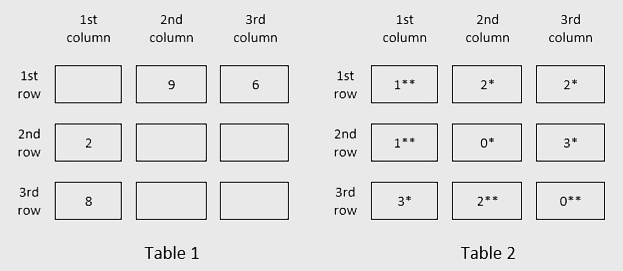
Table 1 gives information regarding the median of the numbers of coins in the three sacks in a box for some of the boxes. In Table 2 each box has a number which represents the number of sacks in that box having more than 5 coins. That number is followed by a * if the sacks in that box satisfy exactly one among the following three conditions, and it is followed by ** if two or more of these conditions are satisfied.
i) The minimum among the numbers of coins in the three sacks in the box is 1.
ii) The median of the numbers of coins in the three sacks is 1.
iii) The maximum among the numbers of coins in the three sacks in the box is 9. - There are nine boxes arranged in a 3×3 array as shown in Tables 1 and 2.

Each box contains three sacks. Each sack has a certain number of coins, between 1 and 9, both inclusive.
The average number of coins per sack in the boxes are all distinct integers. The total number of coins in each row is the same.
The total number of coins in each column is also the same. Table 1 gives information regarding the median of the numbers of coins in the three sacks in a box for some of the boxes. In Table 2 each box has a number which represents the number of sacks in that box having more than 5 coins. That number is followed by a * if the sacks in that box satisfy exactly one among the following three conditions, and it is followed by ** if two or more of these conditions are satisfied.
i) The minimum among the numbers of coins in the three sacks in the box is 1.
ii) The median of the numbers of coins in the three sacks is 1.
iii) The maximum among the numbers of coins in the three sacks in the box is 9. - Want to practice more? Try solving extra ecology questions todayView All Questions