As per the given figure, a small ball $P$ slides down the quadrant of a circle and hits the other ball $Q$ of equal mass which is initially at rest Neglecting the effect of friction and assume the collision to be elastic, the velocity of ball $Q$ after collision will be :$\left( g =10 \,m / s ^2\right)$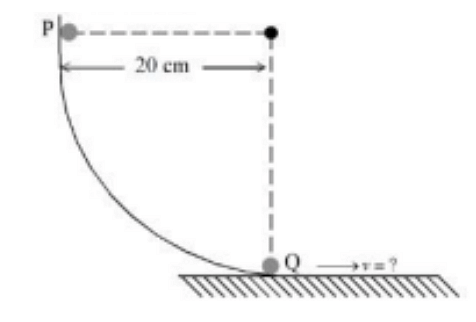
As per the given figure, a small ball $P$ slides down the quadrant of a circle and hits the other ball $Q$ of equal mass which is initially at rest Neglecting the effect of friction and assume the collision to be elastic, the velocity of ball $Q$ after collision will be :$\left( g =10 \,m / s ^2\right)$
- $4\, m / s$
- 0
- $0.25 \,m / s$
- $2\, m / s$
The Correct Option is D
Solution and Explanation
To solve the problem of finding the velocity of ball \(Q\) after an elastic collision, we apply the principles of physics, particularly conservation of energy and conservation of momentum.
- Initial Energy Calculation:
- Ball \(P\) starts sliding from the top of the quadrant. At the top, it only has potential energy.
- The potential energy at the top is given by: \(PE = m \cdot g \cdot h\)
- Since \(h = 20 \, \text{cm} = 0.2 \, \text{m}\), the energy is: \(PE = m \cdot 10 \cdot 0.2 = 2m\) (in joules)
- Energy at the Bottom:
- At the bottom of the quadrant, the potential energy is converted into kinetic energy (neglecting friction).
- Kinetic energy at the bottom of the arc: \(KE = \frac{1}{2} m v^2 = 2m\)
- Solving for \(v\):
\(\frac{1}{2} m v^2 = 2m\)
\(v^2 = 4 \cdot 2\)
\(v = 2 \,\text{m/s}\)
- Conservation of Momentum:
- Initially, ball \(Q\) is at rest, so initial momentum: \(m \cdot 2\text{ (velocity of P)} + m \cdot 0\text{ (velocity of Q)} = 2m\)
- For a perfectly elastic collision, the two balls will exchange velocities since they are of equal mass.
- Thus, after the collision, ball \(Q\) will have the velocity \(2 \, \text{m/s}\).
Therefore, the velocity of ball \(Q\) after collision will be \(2\, \text{m/s}\).
Top Questions on Centre of mass
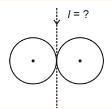
- Two solid spheres each of mass 2 kg and radius 75 cm are arranged as shown. Find MOI of the system about the given axis.
- JEE Main - 2024
- Physics
- Centre of mass
- Three blocks A, B and C are pulled on a horizontal smooth surface by a force of 80 N as shown in figure

The tensions T1 and T2 in the string are respectively:- JEE Main - 2024
- Physics
- Centre of mass
Find the value of m if \(M = 10\) \(kg\). All the surfaces are rough.
- JEE Main - 2024
- Physics
- Centre of mass
A non-uniform bar of weight W is suspended at rest by two strings of negligible weight as shown in Fig.6.33. The angles made by the strings with the vertical are 36.9° and 53.1° respectively. The bar is 2 m long. Calculate the distance d of the centre of gravity of the bar from its left end.

- CBSE Class XI
- Physics
- Centre of mass
- Want to practice more? Try solving extra ecology questions todayView All Questions
