Question:medium
An electromagnetic wave, whose wave normal makes an angle of \( 45^\circ \) with the vertical, is travelling in air and strikes a horizontal liquid surface. While travelling through the liquid, it gets deviated by \( 15^\circ \). If the speed of electromagnetic wave in air is \( 3\times10^8 \text{ m/s} \), then the speed of electromagnetic wave in the liquid will be
An electromagnetic wave, whose wave normal makes an angle of \( 45^\circ \) with the vertical, is travelling in air and strikes a horizontal liquid surface. While travelling through the liquid, it gets deviated by \( 15^\circ \). If the speed of electromagnetic wave in air is \( 3\times10^8 \text{ m/s} \), then the speed of electromagnetic wave in the liquid will be
Show Hint
Remember that \( \frac{1}{\sqrt{2}} \approx 0.707 \). To quickly compute \( \frac{3}{\sqrt{2}} \), you can multiply \( 3 \times 0.707 = 2.12 \). Performing such simple mental calculations helps to find the correct decimal option instantly without extensive division.
Updated On: May 28, 2026
- \( \frac{\sqrt{2}}{3}\times10^8 \text{ m/s} \)
- \( 1.5\times10^8 \text{ m/s} \)
- \( 2.1\times10^8 \text{ m/s} \)
- \( 2.5\times10^8 \text{ m/s} \)
Show Solution
The Correct Option is C
Solution and Explanation
Step 1: Understanding the Concept:
Refraction occurs when an electromagnetic wave transitions from one medium to another, resulting in a change in speed and direction.
The angle of incidence \(i\) is measured from the normal (vertical) to the surface.
Deviation \(\delta\) is the angle between the original path of light and the refracted path.
The angle of refraction \(r\) can be calculated from the deviation.
Snell's Law relates the angles to the speeds of light in the respective media.
Step 2: Key Formula or Approach:
1. Angle relations: \(\delta = i - r\) (when entering a denser medium).
2. Snell's Law in terms of speeds: \(\frac{\sin i}{\sin r} = \frac{v_1}{v_2}\).
3. Given: \(i = 45^\circ\), \(\delta = 15^\circ\), \(v_{air} = 3 \times 10^8 \text{ m/s}\).
Step 3: Detailed Explanation:
The angle of incidence \(i = 45^\circ\).
The wave gets deviated by \(15^\circ\) towards the normal (as it enters a liquid from air).
Angle of refraction \(r = i - \delta = 45^\circ - 15^\circ = 30^\circ\).
Now, apply Snell's Law to find the speed in the liquid \(v_2\):
\[ \frac{\sin i}{\sin r} = \frac{v_{air}}{v_{liquid}} \]
\[ v_{liquid} = v_{air} \frac{\sin r}{\sin i} \]
Substituting the values:
\[ v_{liquid} = (3 \times 10^8) \frac{\sin 30^\circ}{\sin 45^\circ} \]
\[ v_{liquid} = 3 \times 10^8 \times \frac{0.5}{1/\sqrt{2}} = 3 \times 10^8 \times 0.5 \times \sqrt{2} \]
\[ v_{liquid} = 1.5 \times \sqrt{2} \times 10^8 \text{ m/s} \]
Using \(\sqrt{2} \approx 1.414\):
\[ v_{liquid} \approx 1.5 \times 1.414 \times 10^8 \approx 2.121 \times 10^8 \text{ m/s} \]
Rounding to the given options, we get \(2.1 \times 10^8 \text{ m/s}\).
Step 4: Final Answer:
By determining the angle of refraction and applying Snell's Law, the speed of the wave in the liquid is found to be approximately \(2.1 \times 10^8 \text{ m/s}\).
Refraction occurs when an electromagnetic wave transitions from one medium to another, resulting in a change in speed and direction.
The angle of incidence \(i\) is measured from the normal (vertical) to the surface.
Deviation \(\delta\) is the angle between the original path of light and the refracted path.
The angle of refraction \(r\) can be calculated from the deviation.
Snell's Law relates the angles to the speeds of light in the respective media.
Step 2: Key Formula or Approach:
1. Angle relations: \(\delta = i - r\) (when entering a denser medium).
2. Snell's Law in terms of speeds: \(\frac{\sin i}{\sin r} = \frac{v_1}{v_2}\).
3. Given: \(i = 45^\circ\), \(\delta = 15^\circ\), \(v_{air} = 3 \times 10^8 \text{ m/s}\).
Step 3: Detailed Explanation:
The angle of incidence \(i = 45^\circ\).
The wave gets deviated by \(15^\circ\) towards the normal (as it enters a liquid from air).
Angle of refraction \(r = i - \delta = 45^\circ - 15^\circ = 30^\circ\).
Now, apply Snell's Law to find the speed in the liquid \(v_2\):
\[ \frac{\sin i}{\sin r} = \frac{v_{air}}{v_{liquid}} \]
\[ v_{liquid} = v_{air} \frac{\sin r}{\sin i} \]
Substituting the values:
\[ v_{liquid} = (3 \times 10^8) \frac{\sin 30^\circ}{\sin 45^\circ} \]
\[ v_{liquid} = 3 \times 10^8 \times \frac{0.5}{1/\sqrt{2}} = 3 \times 10^8 \times 0.5 \times \sqrt{2} \]
\[ v_{liquid} = 1.5 \times \sqrt{2} \times 10^8 \text{ m/s} \]
Using \(\sqrt{2} \approx 1.414\):
\[ v_{liquid} \approx 1.5 \times 1.414 \times 10^8 \approx 2.121 \times 10^8 \text{ m/s} \]
Rounding to the given options, we get \(2.1 \times 10^8 \text{ m/s}\).
Step 4: Final Answer:
By determining the angle of refraction and applying Snell's Law, the speed of the wave in the liquid is found to be approximately \(2.1 \times 10^8 \text{ m/s}\).
Was this answer helpful?
0
Top Questions on Refraction Through A Prism
- A light ray enters through a right angled prism at point P with the angle of incidence 30° as shown in figure. It travels through the prism parallel to its base BC and emerges along the face AC. The refractive index of the prism is :
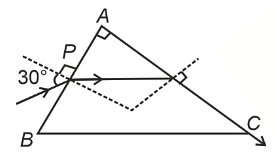
- NEET (UG) - 2024
- Physics
- Refraction Through A Prism
- A laser beam of wavelength 500 nm and power 5 mW strikes normally on a perfectly reflecting surface of area 1 mm\(^2\) of a body. It rebounds back from the surface. Find the force exerted by the laser beam on the body.
- CBSE Class XII - 2025
- Physics
- Refraction Through A Prism
- A ray of light is incident on face AB of a prism ABC with angle of prism \( A \) and emerges out from face AC. The prism is set in the position of minimum deviation with angle of deviation \( \delta \). Find: \begin{enumerate} \item the angle of incidence and \item the angle of refraction on face AB. \end{enumerate}
- CBSE Class XII - 2025
- Physics
- Refraction Through A Prism
- Find the angle of deviation produced by the prism.
- CBSE Class XII - 2025
- Physics
- Refraction Through A Prism
- Want to practice more? Try solving extra ecology questions todayView All Questions