A wire of length L is hanging from a fixed support. The length changes to L1 and L2 when masses 1 kg and 2 kg are suspended, respectively, from its free end. Then the value of L is equal to
- \(\sqrt{L_1L_2}\)
- \(\frac{L_1+L_2}{2}\)
- 2L1 – L2
- 3L1 – 2L2
The Correct Option is C
Solution and Explanation
To find the original length \(L\) of the wire, we need to analyze how the wire stretches under different weights.
Let's consider the problem given:
- The wire stretches to length \(L_1\) when a 1 kg mass is suspended.
- The wire stretches to length \(L_2\) when a 2 kg mass is suspended.
The problem involves the elasticity of the wire. Here, assuming the wire obeys Hooke's Law, the increase in length due to load is proportional to the load applied.
The elongation (change in length) of the wire can be expressed by Hooke’s Law as follows:
\Delta L = \frac{F}{k}
where \(F\) is the force (weight of the mass) and \(k\) is the spring constant of the wire.
Thus for masses 1 kg and 2 kg:
- When a 1 kg mass is attached, the tension is \(T = mg = 1 \times 9.8 = 9.8\, \text{N}\), and the new length is \(L_1\).
- When a 2 kg mass is attached, the tension is \(T = mg = 2 \times 9.8 = 19.6\, \text{N}\), and the new length is \(L_2\).
The increase in length of the wire is directly proportional to the force applied. Therefore, the increase in length from the original length can be written as:
- Increase in length when 1 kg is used: \(L_1 - L = \Delta L_1 = \frac{9.8}{k}\)
- Increase in length when 2 kg is used: \(L_2 - L = \Delta L_2 = \frac{19.6}{k}\)
By subtracting these two equations, we get the relationship:
L_2 - L_1 = \frac{19.6 - 9.8}{k} \rightarrow L_2 - L_1 = \frac{9.8}{k}
This implies that the increase in length for an additional 1 kg load is also \( \Delta L = \frac{9.8}{k}\).
Thus, combining these results, we calculate:
L = 2L_1 - L_2
Therefore, the correct answer is 2L1 – L2.
Top Questions on Centre of mass
- Two solid spheres each of mass 2 kg and radius 75 cm are arranged as shown. Find MOI of the system about the given axis.
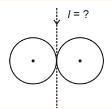
- JEE Main - 2024
- Physics
- Centre of mass
- Three blocks A, B and C are pulled on a horizontal smooth surface by a force of 80 N as shown in figure

The tensions T1 and T2 in the string are respectively:- JEE Main - 2024
- Physics
- Centre of mass
Find the value of m if \(M = 10\) \(kg\). All the surfaces are rough.
- JEE Main - 2024
- Physics
- Centre of mass
A non-uniform bar of weight W is suspended at rest by two strings of negligible weight as shown in Fig.6.33. The angles made by the strings with the vertical are 36.9° and 53.1° respectively. The bar is 2 m long. Calculate the distance d of the centre of gravity of the bar from its left end.

- CBSE Class XI
- Physics
- Centre of mass
- Want to practice more? Try solving extra ecology questions todayView All Questions
