Question:medium
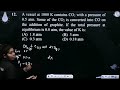
A vessel at 1000 K contains \( \text{CO}_2 \) with a pressure of 0.5 atm. Some of \( \text{CO}_2 \) is converted into \( \text{CO} \) on addition of graphite. If total pressure at equilibrium is 0.8 atm, then \( K_p \) is:
A vessel at 1000 K contains \( \text{CO}_2 \) with a pressure of 0.5 atm. Some of \( \text{CO}_2 \) is converted into \( \text{CO} \) on addition of graphite. If total pressure at equilibrium is 0.8 atm, then \( K_p \) is:
Show Hint
To calculate \( K_p \) for a reaction, use the partial pressures of the products and reactants at equilibrium.
Updated On: Jan 18, 2026
- 0.18 atm
- 1.8 atm
- 0.3 atm
- 3 atm
Show Solution
The Correct Option is B
Solution and Explanation
The equilibrium reaction is \( \text{CO}_2 + C \rightleftharpoons 2\text{CO} \). Initial \( \text{CO}_2 \) pressure is 0.5 atm. At equilibrium, total pressure is 0.8 atm. Let \( x \) represent the change in \( \text{CO}_2 \) pressure. Thus, \( x \) atm of \( \text{CO}_2 \) is consumed, and \( 2x \) atm of \( \text{CO} \) is produced.
Initial partial pressures:
| Substance | \( \text{CO}_2 \) | \( C \) | \( \text{CO} \) |
|---|---|---|---|
| Initial Pressure (atm) | 0.5 | - | 0 |
| Change in Pressure (atm) | -x | - | +2x |
| Equilibrium Pressure (atm) | 0.5 - x | - | 2x |
The total equilibrium pressure is:
\((0.5-x) + 2x = 0.8\)
Solving for \( x \):
\[0.5 - x + 2x = 0.8\]
\[x = 0.3\]
Consequently, the equilibrium pressure of \( \text{CO}_2 \) is \( 0.5 - 0.3 = 0.2 \) atm, and the equilibrium pressure of \( \text{CO} \) is \( 2 \times 0.3 = 0.6 \) atm.
The equilibrium constant \( K_p \) is calculated as:
\( K_p = \frac{(P_{\text{CO}})^2}{P_{\text{CO}_2}} \)
Substituting the equilibrium pressures:
\[K_p = \frac{(0.6)^2}{0.2} = \frac{0.36}{0.2} = 1.8\, \text{atm}\]
Therefore, \( K_p \) is 1.8 atm.
Was this answer helpful?
2
Learn with videos:
Top Questions on Equilibrium
- Find the solubility product of \( \mathrm{Ba(OH)_2} \)?
Where \( S = 1.73 \times 10^{-14} \).- MHT CET - 2024
- Physics
- Equilibrium
- For the equilibrium reaction: \[ N_2(g) + 3H_2(g) \rightleftharpoons 2NH_3(g) \] At a certain temperature, the equilibrium constant \( K_c \) is 4.0. If the concentrations of \( N_2 \), \( H_2 \), and \( NH_3 \) are 0.2 M, 0.6 M, and 0.4 M, respectively, calculate the reaction quotient \( Q_c \) and determine whether the reaction is at equilibrium.
- MHT CET - 2025
- Chemistry
- Equilibrium
- For the reaction \( \text{N}_2 (\text{g}) + 3\text{H}_2 (\text{g}) \rightleftharpoons 2\text{NH}_3 (\text{g}) \), the equilibrium constant \( K_c \) is \( 4.0 \times 10^{-2} \) at a certain temperature. If the equilibrium concentrations are \( [\text{N}_2] = 0.5 \, \text{M} \) and \( [\text{H}_2] = 1.5 \, \text{M} \), what is the equilibrium concentration of \( \text{NH}_3 \)?
- MHT CET - 2025
- Chemistry
- Equilibrium
An ideal massless spring \( S \) can be compressed \( 1 \) m by a force of \( 100 \) N in equilibrium. The same spring is placed at the bottom of a frictionless inclined plane inclined at \( 30^\circ \) to the horizontal. A \( 10 \) kg block \( M \) is released from rest at the top of the incline and is brought to rest momentarily after compressing the spring by \( 2 \) m. If \( g = 10 \) m/s\( ^2 \), what is the speed of the mass just before it touches the spring?

- BITSAT - 2024
- Physics
- Equilibrium
- Want to practice more? Try solving extra ecology questions todayView All Questions
