Question:medium
A tube of length 50 cm is filled completely with an incompressible liquid of mass 250 g and closed at both ends. The tube is then rotated in horizontal plane about one of its ends with a uniform angular velocity x√F rad s−1. If F be the force exerted by the liquid at the other end then the value of x will be______.
A tube of length 50 cm is filled completely with an incompressible liquid of mass 250 g and closed at both ends. The tube is then rotated in horizontal plane about one of its ends with a uniform angular velocity x√F rad s−1. If F be the force exerted by the liquid at the other end then the value of x will be______.
Updated On: Mar 13, 2026
Show Solution
Correct Answer: 4
Solution and Explanation
To solve this problem, we need to compute the angular velocity \(x\) such that the rotational force exerted by the liquid at the other end of the tube matches \(F\). The tube length \(L\) is 50 cm (0.5 m), and the mass \(m\) of the liquid is 250 g (0.25 kg). Using the concept of rotating systems and centrifugal force, we establish the following:
The centrifugal force exerted by a rotating liquid column of small element \(dm\) at a distance \(r\) from the axis of rotation is given by \(dF = r \cdot d(mr) \cdot \omega^2\), where \(\omega\) is the angular velocity. By integration over the length of the tube, the total force \(F\) at the other end when the system rotates is:
\(F = \int_0^L r \cdot \omega^2 \cdot \frac{dm}{dr} \cdot dr\)
Given that \(dm = \frac{m}{L} \cdot dr\) (uniform mass distribution), substitute into the equation:
\(F = \int_0^L r \cdot \omega^2 \cdot \frac{m}{L} \cdot dr = \frac{m \cdot \omega^2}{L} \cdot \int_0^L r \cdot dr\)
The integration simplifies as:
\(F = \frac{m \cdot \omega^2}{L} \cdot \left[\frac{r^2}{2}\right]_0^L = \frac{m \cdot \omega^2}{L} \cdot \frac{L^2}{2} = \frac{m \cdot \omega^2 \cdot L}{2}\)
Substitute the known values to solve for \(\omega\):
\(F = \frac{0.25 \cdot \omega^2 \cdot 0.5}{2} \Rightarrow F = 0.0625 \cdot \omega^2\)
Since \( \omega = x\sqrt{F} \), substitute and solve for \(x\):
\(F = 0.0625 \cdot (x\sqrt{F})^2 \Rightarrow F = 0.0625 \cdot x^2 \cdot F\)
Simplifying gives \(1 = 0.0625 \cdot x^2\) which leads to:
\(x^2 = \frac{1}{0.0625} = 16 \Rightarrow x = 4\)
Thus, the value of \(x\) is 4, confirming it falls within the expected range of 4 to 4.
Was this answer helpful?
0
Top Questions on Centre of mass
- Two solid spheres each of mass 2 kg and radius 75 cm are arranged as shown. Find MOI of the system about the given axis.
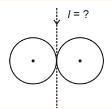
- JEE Main - 2024
- Physics
- Centre of mass
- Three blocks A, B and C are pulled on a horizontal smooth surface by a force of 80 N as shown in figure

The tensions T1 and T2 in the string are respectively:- JEE Main - 2024
- Physics
- Centre of mass
Find the value of m if \(M = 10\) \(kg\). All the surfaces are rough.
- JEE Main - 2024
- Physics
- Centre of mass
A non-uniform bar of weight W is suspended at rest by two strings of negligible weight as shown in Fig.6.33. The angles made by the strings with the vertical are 36.9° and 53.1° respectively. The bar is 2 m long. Calculate the distance d of the centre of gravity of the bar from its left end.

- CBSE Class XI
- Physics
- Centre of mass
- Want to practice more? Try solving extra ecology questions todayView All Questions
