Question:medium
A tiny water droplet falls through the air at a uniform terminal speed of \(1\) cm/s. If \(27\) such identical droplets coalesce to form a single larger drop, what will be the new terminal velocity of the resulting drop, assuming the air remains the same?
A tiny water droplet falls through the air at a uniform terminal speed of \(1\) cm/s. If \(27\) such identical droplets coalesce to form a single larger drop, what will be the new terminal velocity of the resulting drop, assuming the air remains the same?
Show Hint
Terminal speed is proportional to the square of the radius, and the coalesced drop has three times the radius of one droplet.
Updated On: Nov 12, 2026
- \(3\) cm/s
- \(27\) cm/s
- \(81\) cm/s
- \(9\) cm/s
Show Solution
The Correct Option is D
Solution and Explanation
Step 1: Volume conservation
27 droplets of radius $r$ make one drop of radius $R$ with $R^{3}=27r^{3}$, so $R=3r$.
Step 2: Scaling law
$v_{T}\propto r^{2}$, so the speed becomes $3^{2}=9$ times larger.
Step 3: Result
$9\times 1\text{ cm/s}=9\text{ cm/s}$, option (D).
Final Answer:
The coalesced drop falls at 9 cm/s. \[ \boxed{\text{(D) }9\text{ cm/s}} \]
Was this answer helpful?
0
Top Questions on Viscosity
- An air bubble of diameter 6 mm rises steadily through a solution of density 1750kg / m3 at the rate of 0.35 cm/s. The co-efficient of viscosity of the solution (neglect density of air) is ____Pas (given, g = 10ms-2)
- JEE Main - 2023
- Physics
- Viscosity
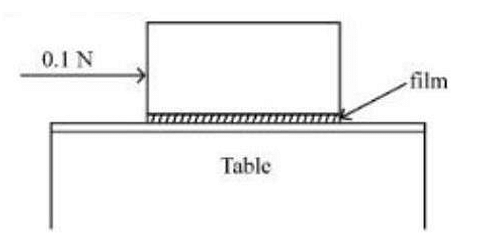
- A metal block of base area \(0.20 \,m^2\) is placed on a table, as shown in figure. A liquid film of thickness \(0.25\, mm\) is inserted between the block and the table. The block is pushed by a horizontal force of 0.1 N and moves with a constant speed. If the viscosity of the liquid is \(5.0×10^{−3}Pl\), the speed of block is ________ \(×10^{−3}m/s\)
- JEE Main - 2023
- Physics
- Viscosity
- The diameter of an air bubble which was initially 2 mm, rises steadily through a solution of density 1750 kg m–3 at the rate of 0.35 cms–1. The coefficient of viscosity of the solution is _______ poise (in nearest integer). (The density of air is negligible).
- JEE Main - 2022
- Physics
- Viscosity
A spherical ball is dropped in a long column of viscous liquid. The speed v of the ball as a function of time t may be best represented by

- BITSAT - 2010
- Physics
- Viscosity
- Want to practice more? Try solving extra ecology questions todayView All Questions