A thin prism having refracting angle 10° is made of glass of refractive index 1.42. This prism is combined with another thin prism of glass of refractive index 1.7. This combination produces dispersion without deviation. The refracting angle of second prism should be
- 4°
- 6°
- 8°
- 10°
The Correct Option is B
Solution and Explanation
To solve this problem, we need to find the refracting angle of the second prism so that the combination of two prisms produces dispersion without deviation.
When two prisms are combined to neutralize their deviations while still creating dispersion, the net deviation produced by the combination should be zero. This condition is known as producing dispersion without deviation. The deviation formula for a prism is:
\(\delta = (n - 1)A\),
where:
- \(\delta\) is the deviation.
- \(n\) is the refractive index of the prism material.
- \(A\) is the refracting angle of the prism.
For the combination of two prisms, the condition to achieve dispersion without deviation is:
(\delta_1 + \delta_2 = 0)
where:
- \(\delta_1 = (n_1 - 1)A_1\) is the deviation by the first prism,
- \(\delta_2 = (n_2 - 1)A_2\) is the deviation by the second prism.
Given values:
- Refracting angle of the first prism A_1 = 10^\circ
- Refractive index of the first prism n_1 = 1.42
- Refractive index of the second prism n_2 = 1.7
According to the condition for dispersion without deviation:
(n_1 - 1)A_1 + (n_2 - 1)A_2 = 0
Substituting the values:
(1.42 - 1)(10^\circ) + (1.7 - 1)A_2 = 0
0.42 \times 10 + 0.7 A_2 = 0
4.2 + 0.7A_2 = 0
Rearranging gives:
0.7A_2 = -4.2
Solving for \(A_2\):
A_2 = \frac{-4.2}{0.7} = -6^\circ
Since the angle cannot be negative, we take the positive equivalent refracting angle:
The refracting angle of the second prism should be 6°.
Top Questions on Refraction Through A Prism
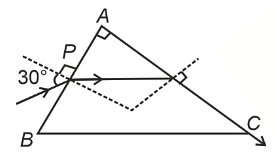
- A light ray enters through a right angled prism at point P with the angle of incidence 30° as shown in figure. It travels through the prism parallel to its base BC and emerges along the face AC. The refractive index of the prism is :
- NEET (UG) - 2024
- Physics
- Refraction Through A Prism
- A laser beam of wavelength 500 nm and power 5 mW strikes normally on a perfectly reflecting surface of area 1 mm\(^2\) of a body. It rebounds back from the surface. Find the force exerted by the laser beam on the body.
- CBSE Class XII - 2025
- Physics
- Refraction Through A Prism
- A ray of light is incident on face AB of a prism ABC with angle of prism \( A \) and emerges out from face AC. The prism is set in the position of minimum deviation with angle of deviation \( \delta \). Find: \begin{enumerate} \item the angle of incidence and \item the angle of refraction on face AB. \end{enumerate}
- CBSE Class XII - 2025
- Physics
- Refraction Through A Prism
- Find the angle of deviation produced by the prism.
- CBSE Class XII - 2025
- Physics
- Refraction Through A Prism
- Want to practice more? Try solving extra ecology questions todayView All Questions

