A thin circular ring of mass M and radius R is rotating with a constant angular velocity 2 rad s–1 in a horizontal plane about an axis vertical to its plane and passing through the center of the ring. If two objects each of mass m be attached gently to the opposite ends of a diameter of ring, the ring will then rotate with an angular velocity (in rad s–1)
\(\frac{M}{M+m}\)
\(\frac{M+2m}{2M}\)
\(\frac{2M}{M+2m}\)
\(\frac{2(M+2m)}{M}\)
The Correct Option is C
Solution and Explanation
To solve this problem, we need to understand the concept of conservation of angular momentum. When no external torque is acting on a system, the angular momentum of the system remains conserved.
Initially, we have a thin circular ring of mass \(M\) and radius \(R\) rotating with an angular velocity \(\omega = 2 \text{ rad s}^{-1}\). The moment of inertia of the ring about its central axis is given by:
I_i = MR^2
The initial angular momentum \(L_i\) is:
L_i = I_i \cdot \omega = MR^2 \cdot 2
Now, when two masses \(m\) are attached to the opposite ends of the diameter of the ring, the new moment of inertia \(I_f\) becomes:
I_f = MR^2 + 2m \left(\frac{R}{2}\right)^2
Here, both masses are situated at a distance \(\frac{R}{2}\) from the center of the ring (since they are added at the diameter end). Therefore, the new moment of inertia becomes:
I_f = MR^2 + 2m \cdot \frac{R^2}{4} = MR^2 + \frac{mR^2}{2}
By simplifying further:
I_f = (M + \frac{m}{2})R^2
According to the conservation of angular momentum:
L_i = L_f
Thus,
MR^2 \cdot 2 = (M + \frac{m}{2})R^2 \cdot \omega_f
Solving for the final angular velocity \(\omega_f\):
\omega_f = \frac{2M}{M + \frac{m}{2}}
Now substituting the condition \(m = 2\), we simplify:
\omega_f = \frac{2M}{M + 2m}
This shows that the correct answer is indeed \(\frac{2M}{M+2m}\) , matching the provided correct option.
Top Questions on Centre of mass
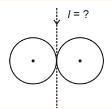
- Two solid spheres each of mass 2 kg and radius 75 cm are arranged as shown. Find MOI of the system about the given axis.
- JEE Main - 2024
- Physics
- Centre of mass
- Three blocks A, B and C are pulled on a horizontal smooth surface by a force of 80 N as shown in figure

The tensions T1 and T2 in the string are respectively:- JEE Main - 2024
- Physics
- Centre of mass
Find the value of m if \(M = 10\) \(kg\). All the surfaces are rough.
- JEE Main - 2024
- Physics
- Centre of mass
A non-uniform bar of weight W is suspended at rest by two strings of negligible weight as shown in Fig.6.33. The angles made by the strings with the vertical are 36.9° and 53.1° respectively. The bar is 2 m long. Calculate the distance d of the centre of gravity of the bar from its left end.

- CBSE Class XI
- Physics
- Centre of mass
- Want to practice more? Try solving extra ecology questions todayView All Questions
