Question:medium
A small steel ball of mass ' M ', radius ' R ' and density ' \(\rho\) ' falls with terminal velocity through a tube filled with glycerine of density ' \(\sigma\) '. The viscous force acting on the steel ball is ( \(\mathrm{g}=\) acceleration due to gravity)
A small steel ball of mass ' M ', radius ' R ' and density ' \(\rho\) ' falls with terminal velocity through a tube filled with glycerine of density ' \(\sigma\) '. The viscous force acting on the steel ball is ( \(\mathrm{g}=\) acceleration due to gravity)
Show Hint
At terminal velocity the viscous force equals weight minus buoyant force.
Updated On: Nov 13, 2026
\(\mathrm{Mg}\frac{\rho}{\sigma}\)
\(\mathrm{Mg}(\mathrm{Q}-\sigma )\)
\(\mathrm{Mg}\rho \sigma\)
\(Mg(1-\frac{\sigma}{\rho})\)
Show Solution
The Correct Option is D
Solution and Explanation
Step 1: Balance of Forces
$F_v = W - F_B$.
Step 2: Buoyancy in Terms of Weight
$F_B = W\cdot\dfrac{\sigma}{\rho}$ since the displaced liquid has the same volume as the ball.
Step 3: Result
$F_v = Mg\left(1 - \dfrac\sigma\rho\right)$, option D.
Final Answer:
F_v equals Mg(1 - sigma/rho). \[ \boxed{\text{(D) }Mg\left(1-\dfrac{\sigma}{\rho}\right)} \]
Was this answer helpful?
0
Top Questions on Viscosity
- An air bubble of diameter 6 mm rises steadily through a solution of density 1750kg / m3 at the rate of 0.35 cm/s. The co-efficient of viscosity of the solution (neglect density of air) is ____Pas (given, g = 10ms-2)
- JEE Main - 2023
- Physics
- Viscosity
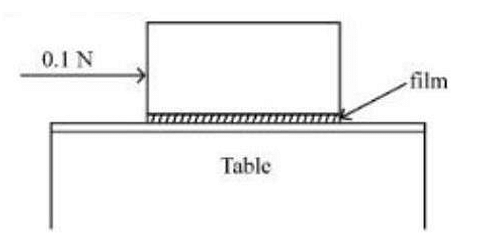
- A metal block of base area \(0.20 \,m^2\) is placed on a table, as shown in figure. A liquid film of thickness \(0.25\, mm\) is inserted between the block and the table. The block is pushed by a horizontal force of 0.1 N and moves with a constant speed. If the viscosity of the liquid is \(5.0×10^{−3}Pl\), the speed of block is ________ \(×10^{−3}m/s\)
- JEE Main - 2023
- Physics
- Viscosity
- The diameter of an air bubble which was initially 2 mm, rises steadily through a solution of density 1750 kg m–3 at the rate of 0.35 cms–1. The coefficient of viscosity of the solution is _______ poise (in nearest integer). (The density of air is negligible).
- JEE Main - 2022
- Physics
- Viscosity
A spherical ball is dropped in a long column of viscous liquid. The speed v of the ball as a function of time t may be best represented by

- BITSAT - 2010
- Physics
- Viscosity
- Want to practice more? Try solving extra ecology questions todayView All Questions