Question:medium
A small ball of mass \(M\), radius \(R\) and density \(\rho\) moves with terminal velocity \(V\) through a container filled with glycerin. If the density of glycerin is \(\sigma\), the viscous force acting on the ball is (\(g\) = gravitational acceleration)
A small ball of mass \(M\), radius \(R\) and density \(\rho\) moves with terminal velocity \(V\) through a container filled with glycerin. If the density of glycerin is \(\sigma\), the viscous force acting on the ball is (\(g\) = gravitational acceleration)
Show Hint
At terminal velocity the net force is zero, so weight equals upthrust plus viscous force.
Updated On: Nov 12, 2026
- \(Mg(\rho -\sigma )\)
- \(Mg\left(1-\frac{\sigma }{\rho }\right)\)
- \(Mg\rho \sigma\)
- \(Mg\left(\frac{\rho }{\sigma }\right)\)
Show Solution
The Correct Option is B
Solution and Explanation
Step 1: Formula-first approach
Net force zero: $Mg=U+F_{v}$, where $U$ is the weight of glycerin displaced.
Step 2: Substitute
$U=\dfrac{M}{\rho}\sigma g$, so $F_{v}=Mg-Mg\dfrac{\sigma}{\rho}$.
Step 3: Why the other options fail
$Mg(\rho-\sigma)$ and $Mg\rho\sigma$ have wrong dimensions, since densities cannot multiply a force. $Mg\dfrac{\rho}{\sigma}$ ignores the upthrust and inverts the density ratio.
Final Answer:
The viscous force equals Mg(1 − σ/ρ). \[ \boxed{\text{(B) }Mg\left(1-\dfrac{\sigma}{\rho}\right)} \]
Was this answer helpful?
0
Top Questions on Viscosity
- An air bubble of diameter 6 mm rises steadily through a solution of density 1750kg / m3 at the rate of 0.35 cm/s. The co-efficient of viscosity of the solution (neglect density of air) is ____Pas (given, g = 10ms-2)
- JEE Main - 2023
- Physics
- Viscosity
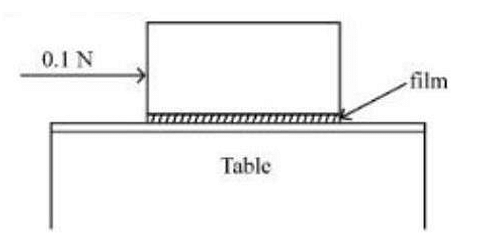
- A metal block of base area \(0.20 \,m^2\) is placed on a table, as shown in figure. A liquid film of thickness \(0.25\, mm\) is inserted between the block and the table. The block is pushed by a horizontal force of 0.1 N and moves with a constant speed. If the viscosity of the liquid is \(5.0×10^{−3}Pl\), the speed of block is ________ \(×10^{−3}m/s\)
- JEE Main - 2023
- Physics
- Viscosity
- The diameter of an air bubble which was initially 2 mm, rises steadily through a solution of density 1750 kg m–3 at the rate of 0.35 cms–1. The coefficient of viscosity of the solution is _______ poise (in nearest integer). (The density of air is negligible).
- JEE Main - 2022
- Physics
- Viscosity
A spherical ball is dropped in a long column of viscous liquid. The speed v of the ball as a function of time t may be best represented by

- BITSAT - 2010
- Physics
- Viscosity
- Want to practice more? Try solving extra ecology questions todayView All Questions