Question:hard
A ray of light is incident at an angle of $60^\circ$ on face AB of prism ABC with $\angle A = 30^\circ$. The ray emerging out of the prism makes an angle of $30^\circ$ with the incident ray. The angle of emergence ($\angle e$) is equal to:
A ray of light is incident at an angle of $60^\circ$ on face AB of prism ABC with $\angle A = 30^\circ$. The ray emerging out of the prism makes an angle of $30^\circ$ with the incident ray. The angle of emergence ($\angle e$) is equal to:
Show Hint
Use deviation = i + e - A with deviation 30 degrees, i = 60 degrees and A = 30 degrees.
Updated On: Oct 21, 2026
- $0^\circ$
- $30^\circ$
- $60^\circ$
- $90^\circ$
Show Solution
The Correct Option is A
Solution and Explanation
Step 1: Use the ray geometry inside the prism:
Let $r_1$ and $r_2$ be the angles of refraction at the first face and of incidence at the second face.
For any prism, $r_1 + r_2 = A = 30^\circ$.
Step 2: Use the deviation:
The ray bends by $(i - r_1)$ at the first face and by $(e - r_2)$ at the second face.
The total deviation is $\delta = (i - r_1) + (e - r_2) = 30^\circ$.
\[ (60^\circ - r_1) + (e - r_2) = 30^\circ \]
Step 3: Solve for $e$:
Put $r_1 + r_2 = 30^\circ$ into the line above.
\[ 60^\circ + e - 30^\circ = 30^\circ \]
\[ e = 0^\circ \]
Step 4: Test each option against the deviation:
For $e = 30^\circ$, $\delta = 60 + 30 - 30 = 60^\circ$. This is not $30^\circ$.
For $e = 60^\circ$, $\delta = 90^\circ$. This is not $30^\circ$.
For $e = 90^\circ$, $\delta = 120^\circ$. This is not $30^\circ$.
Only $e = 0^\circ$ gives $\delta = 30^\circ$.
Final Answer:
The angle of emergence is zero, so the correct option is (A). \[ \boxed{e = 0^\circ} \]
Was this answer helpful?
0
Top Questions on Refraction Through A Prism
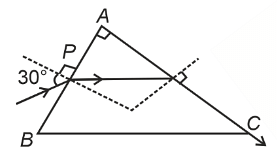
- A light ray enters through a right angled prism at point P with the angle of incidence 30° as shown in figure. It travels through the prism parallel to its base BC and emerges along the face AC. The refractive index of the prism is :
- NEET (UG) - 2024
- Physics
- Refraction Through A Prism
- A laser beam of wavelength 500 nm and power 5 mW strikes normally on a perfectly reflecting surface of area 1 mm\(^2\) of a body. It rebounds back from the surface. Find the force exerted by the laser beam on the body.
- CBSE Class XII - 2025
- Physics
- Refraction Through A Prism
- A ray of light is incident on face AB of a prism ABC with angle of prism \( A \) and emerges out from face AC. The prism is set in the position of minimum deviation with angle of deviation \( \delta \). Find (i) the angle of incidence and (ii) the angle of refraction on face AB.
- CBSE Class XII - 2025
- Physics
- Refraction Through A Prism
- Find the angle of deviation produced by the prism.
- CBSE Class XII - 2025
- Physics
- Refraction Through A Prism
- Want to practice more? Try solving extra ecology questions todayView All Questions