Question:hard
A ray of light is incident at an angle $2A$ on one of the faces of a glass prism of refracting angle $A$. After refraction from this face, the ray strikes the opposite face which is silvered. The reflected ray from this face retraces on its path. Trace the ray diagram and find the relation between the refractive index of material of prism and the angle of prism.
A ray of light is incident at an angle $2A$ on one of the faces of a glass prism of refracting angle $A$. After refraction from this face, the ray strikes the opposite face which is silvered. The reflected ray from this face retraces on its path. Trace the ray diagram and find the relation between the refractive index of material of prism and the angle of prism.
Show Hint
The ray retraces its path only if it meets the silvered face normally, so r2 = 0 and r1 = A. Then use Snell's law at the first face.
Updated On: Oct 21, 2026
Show Solution
Solution and Explanation
Step 1: Draw the path (described):
Take a triangular prism with apex angle A. Face 1 receives the incident ray at an angle 2A from the normal. Inside the glass the ray travels towards face 2, which has a silver coating. Mark the normals at both faces with dashed lines. The ray reflected from face 2 goes back along the refracted ray, so the emergent ray leaves face 1 along the incident ray, in the opposite direction.
Step 2: Geometry of the triangle:
Let the refracted ray meet face 1 at point Q and face 2 at point R. The normals to the two faces meet at a point N. In the quadrilateral with the apex and the two normal feet, the angle at N equals $180^{\circ} - A$.
In triangle QNR the angles are $r_1$, $r_2$ and $180^{\circ} - A$. So $r_1 + r_2 = A$.
Step 3: Use the retracing condition:
A ray retraces its path only if it hits the mirror at 90 degrees. So the angle of incidence on face 2 is zero, $r_2 = 0$, and $r_1 = A$.
Step 4: Refractive index:
Snell's law at face 1: $\sin 2A = \mu \sin A$.
\[ \mu = \frac{\sin 2A}{\sin A} = 2\cos A \]
For example, A = 30 degrees gives $\mu = 2\cos 30^{\circ} = 1.73$, which is a sensible value for glass.
Final Answer:
\[ \boxed{\mu = 2\cos A} \]
Was this answer helpful?
0
Top Questions on Refraction Through A Prism
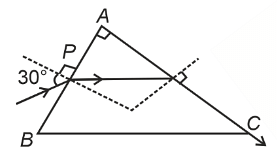
- A light ray enters through a right angled prism at point P with the angle of incidence 30° as shown in figure. It travels through the prism parallel to its base BC and emerges along the face AC. The refractive index of the prism is :
- NEET (UG) - 2024
- Physics
- Refraction Through A Prism
- A laser beam of wavelength 500 nm and power 5 mW strikes normally on a perfectly reflecting surface of area 1 mm\(^2\) of a body. It rebounds back from the surface. Find the force exerted by the laser beam on the body.
- CBSE Class XII - 2025
- Physics
- Refraction Through A Prism
- A ray of light is incident on face AB of a prism ABC with angle of prism \( A \) and emerges out from face AC. The prism is set in the position of minimum deviation with angle of deviation \( \delta \). Find (i) the angle of incidence and (ii) the angle of refraction on face AB.
- CBSE Class XII - 2025
- Physics
- Refraction Through A Prism
- Find the angle of deviation produced by the prism.
- CBSE Class XII - 2025
- Physics
- Refraction Through A Prism
- Want to practice more? Try solving extra ecology questions todayView All Questions