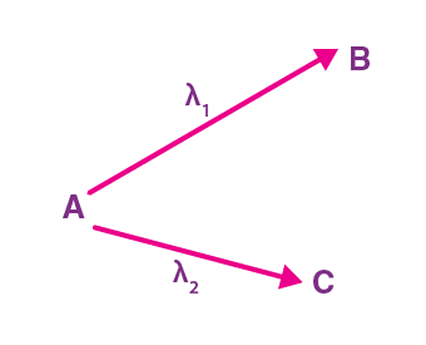
A radioactive nucleus can decay by two different processes. Half-life for the first process is 3.0 hours while it is 4.5 hours for the second process. The effective half-life of the nucleus will be:
- 3.75 hours
- 0.56 hours
- 0.26 hours
- 1.80 hours
The Correct Option is D
Solution and Explanation
To determine the effective half-life of a radioactive nucleus decaying through two processes, the concept of parallel decay processes is used. When a nucleus decays via two simultaneous processes with half-lives T_{1/2,1} and T_{1/2,2}, the effective decay constant \lambda_{eff} is the sum of the individual decay constants:
\lambda_{eff} = \lambda_1 + \lambda_2
where \lambda_1 and \lambda_2 are the decay constants for each process, given by:
\lambda_1 = \frac{\ln(2)}{T_{1/2,1}} and \lambda_2 = \frac{\ln(2)}{T_{1/2,2}}
The effective half-life T_{1/2,eff} can then be calculated using:
T_{1/2,eff} = \frac{\ln(2)}{\lambda_{eff}}
Given:
- T_{1/2,1} = 3.0 hours
- T_{1/2,2} = 4.5 hours
First, find \lambda_1 and \lambda_2:
\lambda_1 = \frac{\ln(2)}{3.0} \approx 0.231 \text{hour}^{-1}
\lambda_2 = \frac{\ln(2)}{4.5} \approx 0.154 \text{hour}^{-1}
Add the decay constants to find \lambda_{eff}:
\lambda_{eff} = 0.231 + 0.154 = 0.385 \text{hour}^{-1}
Now, calculate the effective half-life T_{1/2,eff}:
T_{1/2,eff} = \frac{\ln(2)}{0.385} \approx 1.80 hours
Therefore, the effective half-life of the nucleus is 1.80 hours.
Top Questions on Nuclei
- Differentiate between nuclear fission and fusion.
- Draw the graph showing the variation of scattered particles detected (\( N \)) with the scattering angle (\( \theta \)) in the Geiger-Marsden experiment. Write two conclusions that you can draw from this graph. Obtain the expression for the distance of closest approach in this experiment.
The electric potential at the surface of an atomic nucleus \( (z = 50) \) of radius \( 9 \times 10^{-13} \) cm is \(\_\_\_\_\_\_\_ \)\(\times 10^{6} V\).
- JEE Main - 2024
- Physics
- Nuclei
In a nuclear fission reaction of an isotope of mass \( M \), three similar daughter nuclei of the same mass are formed. The speed of a daughter nuclei in terms of mass defect \( \Delta M \) will be:
- JEE Main - 2024
- Physics
- Nuclei
- Want to practice more? Try solving extra ecology questions todayView All Questions
