Question:medium
A metal block of mass m is suspended from a rigid support through a metal wire of diameter 14 mm. The tensile stress developed in the wire under equilibrium state is 7× 10⁵ Nm-2 . The value of mass m is ___ kg. (Take, g = 9.8 ms-2 and π =\(\frac{ 22}{7}\))
A metal block of mass m is suspended from a rigid support through a metal wire of diameter 14 mm. The tensile stress developed in the wire under equilibrium state is 7× 10⁵ Nm-2 . The value of mass m is ___ kg. (Take, g = 9.8 ms-2 and π =\(\frac{ 22}{7}\))
Updated On: Feb 20, 2026
Show Solution
Correct Answer: 11
Solution and Explanation
| To find the mass \(m\) of the metal block given the tensile stress in the wire, we follow these steps: |
| 1. **Tensile Stress Formula**: The tensile stress (\(\sigma\)) developed in the wire is given by the formula: \[\sigma = \frac{F}{A}\] where \(F\) is the force due to the weight of the block, and \(A\) is the cross-sectional area of the wire. |
| 2. **Determine the Force**: The force \(F\) is due to the weight of the block, hence \(F = mg\), where \(g = 9.8\, \text{m/s}^2\) is the acceleration due to gravity. |
| 3. **Calculate Cross-Sectional Area**: The cross-sectional area \(A\) of the wire with diameter \(d = 14\, \text{mm} = 0.014\, \text{m}\) is given by: \[A = \frac{\pi d^2}{4} = \frac{22}{7} \times \left(\frac{0.014}{2}\right)^2 = \frac{22}{7} \times 0.007^2 = \frac{22}{7} \times 0.000049 = 0.000154\, \text{m}^2\] |
| 4. **Calculate the Mass**: Using the tensile stress formula \(\sigma = \frac{mg}{A}\), rearrange to find \(m\): \[m = \frac{\sigma \times A}{g} = \frac{7 \times 10^5 \times 0.000154}{9.8} = \frac{107.8}{9.8} \approx 11\, \text{kg}\] |
| 5. **Verification**: The calculated mass \(11\, \text{kg}\) is within the expected range of [11, 11]. |
| Therefore, the mass of the metal block is \(11\, \text{kg}\). |
Was this answer helpful?
0
Top Questions on Centre of mass
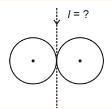
- Two solid spheres each of mass 2 kg and radius 75 cm are arranged as shown. Find MOI of the system about the given axis.
- JEE Main - 2024
- Physics
- Centre of mass
- Three blocks A, B and C are pulled on a horizontal smooth surface by a force of 80 N as shown in figure

The tensions T1 and T2 in the string are respectively:- JEE Main - 2024
- Physics
- Centre of mass
Find the value of m if \(M = 10\) \(kg\). All the surfaces are rough.
- JEE Main - 2024
- Physics
- Centre of mass
A non-uniform bar of weight W is suspended at rest by two strings of negligible weight as shown in Fig.6.33. The angles made by the strings with the vertical are 36.9° and 53.1° respectively. The bar is 2 m long. Calculate the distance d of the centre of gravity of the bar from its left end.

- CBSE Class XI
- Physics
- Centre of mass
- Want to practice more? Try solving extra ecology questions todayView All Questions
