Question:medium
A cylindrical metal box whose flat surface has an area of \(0.01\text{ m}^2\) rests on liquid of \(0.3\text{ mm}\) thickness. If upon applying a horizontal force of magnitude \(\frac{1}{3}\text{ N}\), the box slides with a constant speed of \(0.09\text{ m s}^{-1}\), the coefficient of viscosity of the liquid is nearly
A cylindrical metal box whose flat surface has an area of \(0.01\text{ m}^2\) rests on liquid of \(0.3\text{ mm}\) thickness. If upon applying a horizontal force of magnitude \(\frac{1}{3}\text{ N}\), the box slides with a constant speed of \(0.09\text{ m s}^{-1}\), the coefficient of viscosity of the liquid is nearly
Show Hint
For a body moving over a thin liquid layer, viscous force is given by
\[
F=\eta A\frac{v}{d}.
\]
Always convert thickness from mm to m before substitution.
Updated On: Jun 25, 2026
- \(2.5\times 10^{-2}\text{ Pa.s}\)
- \(1.1\times 10^{-1}\text{ Pa.s}\)
- \(1.1\times 10^{-2}\text{ Pa.s}\)
- \(2.5\times 10^{-1}\text{ Pa.s}\)
Show Solution
The Correct Option is B
Solution and Explanation
Step 1: Recall Newton's law of viscosity.
When a flat object slides at constant velocity over a thin liquid layer: $F = \eta A \frac{v}{d}$, where $\eta$ is viscosity, $A$ is area, $v$ is speed, $d$ is layer thickness. At constant velocity, applied force equals viscous drag.
Step 2: Rearrange to isolate $\eta$.
\[ \eta = \frac{Fd}{Av} \]
Step 3: Convert all values to SI units.
$F = \frac{1}{3}$ N, $d = 3 \times 10^{-4}$ m, $A = 0.01$ m$^2$, $v = 0.09$ ms$^{-1}$.
Step 4: Substitute and simplify.
\[ \eta = \frac{\frac{1}{3} \times 3 \times 10^{-4}}{0.01 \times 0.09} = \frac{10^{-4}}{9 \times 10^{-4}} = \frac{1}{9} \approx 0.111 \text{ Pa.s} \]
Step 5: Express in scientific notation.
$\eta \approx 1.1 \times 10^{-1}$ Pa.s, about 100 times more viscous than water ($10^{-3}$ Pa.s).
Step 6: State the final answer.
\[ \boxed{\eta \approx 1.1 \times 10^{-1} \text{ Pa.s}} \]
When a flat object slides at constant velocity over a thin liquid layer: $F = \eta A \frac{v}{d}$, where $\eta$ is viscosity, $A$ is area, $v$ is speed, $d$ is layer thickness. At constant velocity, applied force equals viscous drag.
Step 2: Rearrange to isolate $\eta$.
\[ \eta = \frac{Fd}{Av} \]
Step 3: Convert all values to SI units.
$F = \frac{1}{3}$ N, $d = 3 \times 10^{-4}$ m, $A = 0.01$ m$^2$, $v = 0.09$ ms$^{-1}$.
Step 4: Substitute and simplify.
\[ \eta = \frac{\frac{1}{3} \times 3 \times 10^{-4}}{0.01 \times 0.09} = \frac{10^{-4}}{9 \times 10^{-4}} = \frac{1}{9} \approx 0.111 \text{ Pa.s} \]
Step 5: Express in scientific notation.
$\eta \approx 1.1 \times 10^{-1}$ Pa.s, about 100 times more viscous than water ($10^{-3}$ Pa.s).
Step 6: State the final answer.
\[ \boxed{\eta \approx 1.1 \times 10^{-1} \text{ Pa.s}} \]
Was this answer helpful?
0
Top Questions on Viscosity
- An air bubble of diameter 6 mm rises steadily through a solution of density 1750kg / m3 at the rate of 0.35 cm/s. The co-efficient of viscosity of the solution (neglect density of air) is ____Pas (given, g = 10ms-2)
- JEE Main - 2023
- Physics
- Viscosity
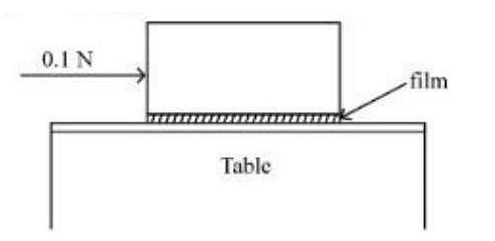
- A metal block of base area \(0.20 \,m^2\) is placed on a table, as shown in figure. A liquid film of thickness \(0.25\, mm\) is inserted between the block and the table. The block is pushed by a horizontal force of 0.1 N and moves with a constant speed. If the viscosity of the liquid is \(5.0×10^{−3}Pl\), the speed of block is ________ \(×10^{−3}m/s\)
- JEE Main - 2023
- Physics
- Viscosity
- The diameter of an air bubble which was initially 2 mm, rises steadily through a solution of density 1750 kg m–3 at the rate of 0.35 cms–1. The coefficient of viscosity of the solution is _______ poise (in nearest integer). (The density of air is negligible).
- JEE Main - 2022
- Physics
- Viscosity
A spherical ball is dropped in a long column of viscous liquid. The speed v of the ball as a function of time t may be best represented by

- BITSAT - 2010
- Physics
- Viscosity
- Want to practice more? Try solving extra ecology questions todayView All Questions