A bought a phone from a store and paid \(\frac{1}{6}\) of the price using UPI, \(\frac{1}{3}\) of the price in cash, and the remaining balance a year later. He also paid 10% interest on the remaining balance after one year. What was the original price of the phone?
Show Hint
- Rs.12,000
- Rs.18,000
- Rs.24,000
- Rs.30,000
The Correct Option is C
Solution and Explanation
Let the original price of the phone be denoted by \(P\).
Amount Paid via UPI:
\(\frac{1}{6}P\)
Amount Paid in Cash:
\(\frac{1}{3}P\)
Remaining Balance:
\(P - \left(\frac{1}{6}P + \frac{1}{3}P\right) = P - \frac{1}{2}P = \frac{1}{2}P\)
Interest Paid on Remaining Balance: 10% interest was paid on the remaining balance \(\left(\frac{1}{2}P\right)\):
Interest = \(0.1 \times \frac{1}{2}P = \frac{1}{20}P\)
Total Amount Paid After a Year:
\(\frac{1}{2}P + \frac{1}{20}P = \frac{10}{20}P + \frac{1}{20}P = \frac{11}{20}P\)
Simplify the Equation: Express all terms with a common denominator (LCM of 6, 3, and 20 is 60):
\[ \frac{10}{60}P + \frac{20}{60}P + \frac{33}{60}P = P \]
\[ \frac{63}{60}P = P \]
This equation is valid, indicating that the price aligns with the proportional payments. Based on the provided options, the original price of the phone is Rs. 24,000.
Top Questions on Percentage
- Given \(A=x+y^2+z^3\). If x increases by 6300%, y increases by 700% and z increases by 300%, then what is the percentage increase in the value of A?
- IBSAT
- Quantitative Aptitude
- Percentage
- The populations of two cities X and Y is equal. The population of city X increases in two successive years by 15% and 20% respectively and that of city Y increases successively by 10% and 30% respectively. If the difference in the population of two cities after 2 years is 55,980, then what was the total population of the two cities initially?
- IBSAT
- Quantitative Aptitude
- Percentage
- A trader buys 240 watches for ` 50,400 and he marks each of them at ` 320. He gives a discount of 15% on each watch and gives 1 watch free on a purchase of 5 watches. What is his minimum possible overall percentage of profit?
- IBSAT
- Quantitative Aptitude
- Percentage
- The ratio of selling prices of four articles is \(3 : 5 : 6 : 8\) and their profits are 20%, 25%, 20% and 25% respectively. What is the overall percentage of profit on selling the four articles?
- IBSAT
- Quantitative Aptitude
- Percentage
- Want to practice more? Try solving extra ecology questions todayView All Questions
Questions Asked in XAT exam
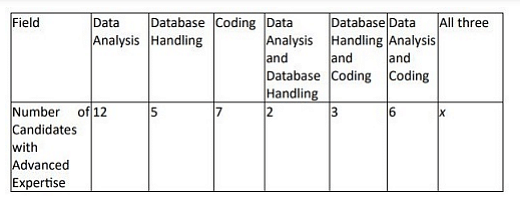
The number of applicants with advanced expertise in all three fields is given as x in the table, where x is a non-negative integer.
- XAT - 2024
- Data Interpretation