Two points R and S are equidistant from two charges \( +Q \) and \( -2Q \). The work done in moving a charge \( -Q \) from point R to S is:
Show Hint
- Zero
- \( - \frac{Q}{4 \pi \epsilon_0 d} \)
- \( \frac{Q}{4 \pi \epsilon_0 d} \)
- \( \frac{3Q}{4 \pi \epsilon_0 d} \)
The Correct Option is A
Solution and Explanation
To determine the work done in moving a charge \( -Q \) from point R to S, we first need to understand the electric potential at these points due to the charges \( +Q \) and \( -2Q \).
Assume the point charges \( +Q \) and \( -2Q \) are located at points A and B, respectively, and R and S are equidistant from A and B. Let the distance from A to R (and S) be \( d_1 \) and from B to R (and S) be \( d_2 \).
The electric potential \( V \) due to a point charge is given by:
\(V = \frac{kQ}{r}\)
where \( k = \frac{1}{4 \pi \epsilon_0} \) is Coulomb's constant and \( r \) is the distance from the charge.
At point R, the potential \( V_R \) is the sum of potentials due to \( +Q \) and \( -2Q \):
\(V_R = \frac{kQ}{d_1} - \frac{2kQ}{d_2}\)
Similarly, at point S, the potential \( V_S \) is:
\(V_S = \frac{kQ}{d_1} - \frac{2kQ}{d_2}\)
Since R and S are equidistant from both charges, the distances \( d_1 \) and \( d_2 \) are the same for points R and S, making \( V_R = V_S \).
The work done \( W \) in moving a charge \( q \) between two points in an electric field is given by:
\(W = q(V_S - V_R)\)
Substituting the values, we have:
\(W = -Q(V_S - V_R)\)
\(W = -Q(\frac{kQ}{d_1} - \frac{2kQ}{d_2} - (\frac{kQ}{d_1} - \frac{2kQ}{d_2}))\)
This simplifies to:
\(W = -Q(0) = 0\)
Therefore, the work done in moving the charge from R to S is Zero. Thus, the correct answer is Zero.
Top Questions on Electric Potential And Potential Difference
- How is a voltmeter connected in the circuit to measure the potential difference between two points?
- CBSE Class X
- Science
- Electric Potential And Potential Difference
- A thin spherical shell is charged by some source. The potential difference between the two points C and P (in V) shown in the figure is:
(Take \(\frac{1}{4}\pi\epsilon_0 = 9 × 10⁹\)\(\frac{1}{4\pi\epsilon_0}=9\times10^9\) SI units)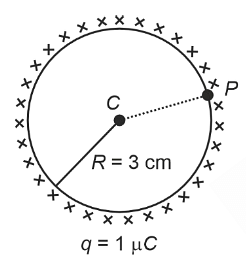
- NEET (UG) - 2024
- Physics
- Electric Potential And Potential Difference
- A charge of 10 coulomb is brought from infinity to a point \( P \) near a charged body and in this process 200 joules of work is done. Electric potential at point \( P \) is:
- JEECUP - 2024
- Physics
- Electric Potential And Potential Difference
Resistance of each side is $R$. Find equivalent resistance between two opposite points as shown in the figure.

- JEE Main - 2026
- Physics
- Electric Potential And Potential Difference
- Want to practice more? Try solving extra ecology questions todayView All Questions