Question:medium
Two hollow conducting spheres of radii R1 and R2 (R1 >>R2) have equal charges. The potential would be:
Two hollow conducting spheres of radii R1 and R2 (R1 >>R2) have equal charges. The potential would be:
Updated On: May 1, 2026
- More on bigger sphere
- More on smaller sphere
- Equal on both the sphere
- Dependent on the material properly of the sphere
Show Solution
The Correct Option is B
Solution and Explanation
Step 1: Understanding the Concept:
For a hollow conducting sphere, the electric potential (\(V\)) on its surface is uniform and is determined by the total charge and the radius of the sphere.
Key Formula or Approach:
The potential \(V\) at the surface of a sphere of radius \(R\) carrying charge \(Q\) is given by:
\[ V = \frac{1}{4\pi\epsilon_0} \frac{Q}{R} \]
Step 2: Detailed Explanation:
Given that both spheres have equal charges (\(Q_1 = Q_2 = Q\)).
The potential of the first sphere is \(V_1 = \frac{1}{4\pi\epsilon_0} \frac{Q}{R_1}\).
The potential of the second sphere is \(V_2 = \frac{1}{4\pi\epsilon_0} \frac{Q}{R_2}\).
From these equations, it is clear that for a constant charge \(Q\):
\[ V \propto \frac{1}{R} \]
Since it is given that \(R_1 >> R_2\), it follows that:
\[ \frac{1}{R_2}>\frac{1}{R_1} \implies V_2>V_1 \]
Thus, the smaller sphere (\(R_2\)) has a higher potential.
Step 3: Final Answer:
The potential will be more on the smaller sphere.
For a hollow conducting sphere, the electric potential (\(V\)) on its surface is uniform and is determined by the total charge and the radius of the sphere.
Key Formula or Approach:
The potential \(V\) at the surface of a sphere of radius \(R\) carrying charge \(Q\) is given by:
\[ V = \frac{1}{4\pi\epsilon_0} \frac{Q}{R} \]
Step 2: Detailed Explanation:
Given that both spheres have equal charges (\(Q_1 = Q_2 = Q\)).
The potential of the first sphere is \(V_1 = \frac{1}{4\pi\epsilon_0} \frac{Q}{R_1}\).
The potential of the second sphere is \(V_2 = \frac{1}{4\pi\epsilon_0} \frac{Q}{R_2}\).
From these equations, it is clear that for a constant charge \(Q\):
\[ V \propto \frac{1}{R} \]
Since it is given that \(R_1 >> R_2\), it follows that:
\[ \frac{1}{R_2}>\frac{1}{R_1} \implies V_2>V_1 \]
Thus, the smaller sphere (\(R_2\)) has a higher potential.
Step 3: Final Answer:
The potential will be more on the smaller sphere.
Was this answer helpful?
1
Top Questions on Electric Potential And Potential Difference
- How is a voltmeter connected in the circuit to measure the potential difference between two points?
- CBSE Class X
- Science
- Electric Potential And Potential Difference
- A thin spherical shell is charged by some source. The potential difference between the two points C and P (in V) shown in the figure is:
(Take \(\frac{1}{4}\pi\epsilon_0 = 9 × 10⁹\)\(\frac{1}{4\pi\epsilon_0}=9\times10^9\) SI units)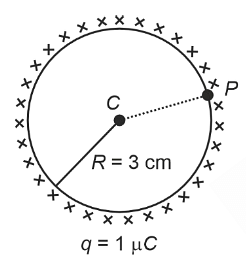
- NEET (UG) - 2024
- Physics
- Electric Potential And Potential Difference
- A charge of 10 coulomb is brought from infinity to a point \( P \) near a charged body and in this process 200 joules of work is done. Electric potential at point \( P \) is:
- JEECUP - 2024
- Physics
- Electric Potential And Potential Difference
Resistance of each side is $R$. Find equivalent resistance between two opposite points as shown in the figure.

- JEE Main - 2026
- Physics
- Electric Potential And Potential Difference
- Want to practice more? Try solving extra ecology questions todayView All Questions

