"Things which matter most must never be at the mercy of things which matter least."( Maximum 250 words)
Solution and Explanation
This statement advocates for life prioritization, directing individuals to concentrate on significant matters and disregard trivialities. In a world saturated with diversions, the skill of prioritization is vital.
First, self-reflection is necessary to identify core priorities. Objectives, connections, well-being, and self-improvement should supersede minor disputes, material acquisitions, or transient distractions. For example, investing time with family or pursuing a fulfilling career yields lasting value, unlike expending hours on insignificant online arguments.
Second, efficient time allocation is crucial. Task classification into urgent, important, or negligible categories ensures that primary objectives are achieved promptly. The Eisenhower Matrix, for instance, is a useful tool for priority management.
Third, disciplined priority selection mitigates the "tyranny of the urgent," wherein immediate yet minor tasks eclipse vital long-term aims. Stephen Covey's work emphasizes that concentrating on "important but not urgent" tasks fosters genuine productivity and satisfaction.
In summary, this principle stresses intentional living. By allocating time and effort to what genuinely matters, individuals can achieve purposeful, fulfilling lives and avoid remorse over overlooked priorities.
Top Questions on Time Management
- Zainab switched her job from night shift to morning shift. You have advised her to make a time plan for the new work timings. Explain to her the various steps of making a time plan.
- CBSE Class X - 2024
- Home Science
- Time Management
- Explain, by giving three reasons, why time management is essential in daily life.
- CBSE Class X - 2024
- Home Science
- Time Management
- Ria washes dirty dishes while cooking food side by side in the kitchen. What is performing of two tasks at the same time known as?
- CBSE Class X - 2024
- Home Science
- Time Management
- When two activities are grouped together and scheduled together to save time and energy, it is called __________
- CBSE Class XII - 2026
- Home Science
- Time Management
- Want to practice more? Try solving extra ecology questions todayView All Questions
Questions Asked in XAT exam
The number of applicants with advanced expertise in all three fields is given as x in the table, where x is a non-negative integer.
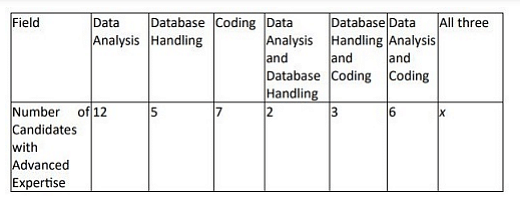
- XAT - 2024
- Data Interpretation