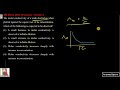
The molar conductivity of a weak electrolyte when plotted against the square root of its concentration, which of the following is expected to be observed?
Show Hint
- Molar conductivity decreases sharply with increase in concentration.
- A small increase in molar conductivity is observed at infinite dilution.
- Molar conductivity increases sharply with increase in concentration.
- A small decrease in molar conductivity is observed at infinite dilution.
The Correct Option is A
Solution and Explanation
Molar conductivity for a weak electrolyte generally shows a precipitous decline as concentration rises. This phenomenon is attributable to the following factors:
1. Molar Conductivity Defined: Molar conductivity (Λm) quantifies the conductivity of a solution relative to the electrolyte's molar concentration. It is calculated as:
Λm = κ/C
where κ represents conductivity and C denotes electrolyte concentration.
2. Weak Electrolyte Ionization Dynamics: Weak electrolytes exhibit incomplete ionization in solution. At elevated concentrations, the extent of ionization diminishes due to increased proximity of ions, leading to enhanced inter-ionic interactions and consequently, diminished ion mobility.
3. Impact of Concentration on Ion Interactions: Higher concentrations intensify ion-ion interactions. These electrostatic forces impede ion movement. Consequently, a reduced number of ions contribute to conductivity, thereby lowering molar conductivity.
4. Behavior at Infinite Dilution: At extreme dilutions (infinite dilution), ions are maximally separated, minimizing their interactions. This maximizes ion mobility, resulting in the highest achievable molar conductivity for the electrolyte.
In essence, an increase in weak electrolyte concentration leads to a pronounced decrease in molar conductivity, driven by amplified ion interactions and reduced ion mobility.
Learn with videos:
Top Questions on Conductance of Electrolytic Solutions
- What is the correct expression for the molar conductivity (\( \Lambda^\circ_m \)) of Al\(_2\)(SO\(_4\))\(_3\) at infinite dilution?
- BCECE - 2025
- Chemistry
- Conductance of Electrolytic Solutions
In very high electric field \( E > 10^5 \),
(A) Asymmetric affect disappears
(B) Electrophoretic affect disappears
(C) The ion moves so rapidly that it loses its ionic atmosphere.
(D) The weak electrolyte is completely ionised at all dilutions.
- CUET (PG) - 2025
- Chemistry
- Conductance of Electrolytic Solutions
Given below are two statements:
Statement I: Benzene is nitrated to give nitrobenzene, which on further treatment with \( \text{CH}_3\text{COCl} / \text{AlCl}_3 \) will give the product shown.
Statement II: \( -\text{NO}_2 \) group is a meta-directing and deactivating group.
In the light of the above statements, choose the most appropriate answer from the options given below.- JEE Main - 2026
- Chemistry
- Conductance of Electrolytic Solutions
- The molar conductivities of a divalent cation (M2+) and monovalent anion (A-) are 57 S cm-1 mol-1 and 73 S cm-1 mol-1 respectively. Then find the total molar conductivity shown by their compound in S cm-1 mol-1
- Want to practice more? Try solving extra ecology questions todayView All Questions
