Question:medium
The line integral of the magnetic field around a closed loop is directly proportional to the ________.
The line integral of the magnetic field around a closed loop is directly proportional to the ________.
Show Hint
Ampere's Law is the magnetic equivalent of Gauss's Law in electrostatics.
Updated On: Jun 26, 2026
- current enclosed
- charge enclosed
- voltage across the loop
- length of the loop
- electric field around the loop
Show Solution
The Correct Option is A
Solution and Explanation
Step 1: Understanding the Concept
This question is a statement of Ampere's Circuital Law, one of Maxwell's four fundamental equations of electromagnetism. It relates the magnetic field along a closed path to the electric current passing through the area enclosed by that path.
Step 2: Key Formula or Approach
Ampere's Circuital Law is mathematically stated as:
\[ \oint \vec{B} \cdot d\vec{l} = \mu_0 I_{enc} \] where:
- \(\oint \vec{B} \cdot d\vec{l}\) is the line integral of the magnetic field \(\vec{B}\) around a closed loop (an Amperian loop).
- \(\mu_0\) is the permeability of free space, a fundamental constant.
- \(I_{enc}\) is the total net electric current enclosed by the loop.
Step 3: Detailed Explanation
The law states that the line integral of the magnetic field (\(\oint \vec{B} \cdot d\vec{l}\)) is directly proportional to the net electric current (\(I_{enc}\)) enclosed by the loop. The constant of proportionality is \(\mu_0\).
Let's evaluate the options based on this law:
(A) current enclosed: Correct. This is exactly what Ampere's Law states.
(B) charge enclosed: Incorrect. This relates to Gauss's Law for electricity (\(\oint \vec{E} \cdot d\vec{A} = Q_{enc}/\epsilon_0\)), not magnetism.
(C) voltage across the loop: Incorrect. This relates to Faraday's Law of Induction, where the line integral of the electric field (EMF) is related to the rate of change of magnetic flux.
(D) length of the loop: Incorrect. The value of the integral depends on the path, but it is not directly proportional to the total length of the loop in general.
(E) electric field around the loop: Incorrect.
Step 4: Final Answer
The line integral of the magnetic field around a closed loop is directly proportional to the current enclosed.
This question is a statement of Ampere's Circuital Law, one of Maxwell's four fundamental equations of electromagnetism. It relates the magnetic field along a closed path to the electric current passing through the area enclosed by that path.
Step 2: Key Formula or Approach
Ampere's Circuital Law is mathematically stated as:
\[ \oint \vec{B} \cdot d\vec{l} = \mu_0 I_{enc} \] where:
- \(\oint \vec{B} \cdot d\vec{l}\) is the line integral of the magnetic field \(\vec{B}\) around a closed loop (an Amperian loop).
- \(\mu_0\) is the permeability of free space, a fundamental constant.
- \(I_{enc}\) is the total net electric current enclosed by the loop.
Step 3: Detailed Explanation
The law states that the line integral of the magnetic field (\(\oint \vec{B} \cdot d\vec{l}\)) is directly proportional to the net electric current (\(I_{enc}\)) enclosed by the loop. The constant of proportionality is \(\mu_0\).
Let's evaluate the options based on this law:
(A) current enclosed: Correct. This is exactly what Ampere's Law states.
(B) charge enclosed: Incorrect. This relates to Gauss's Law for electricity (\(\oint \vec{E} \cdot d\vec{A} = Q_{enc}/\epsilon_0\)), not magnetism.
(C) voltage across the loop: Incorrect. This relates to Faraday's Law of Induction, where the line integral of the electric field (EMF) is related to the rate of change of magnetic flux.
(D) length of the loop: Incorrect. The value of the integral depends on the path, but it is not directly proportional to the total length of the loop in general.
(E) electric field around the loop: Incorrect.
Step 4: Final Answer
The line integral of the magnetic field around a closed loop is directly proportional to the current enclosed.
Was this answer helpful?
0
Top Questions on Amperes circuital law
- A coil has a resistance of \( 30 \, \Omega \) and an inductive reactance of \( 20 \, \Omega \) at 50 Hz frequency. If an AC source of 200 V and 100 Hz is connected across the coil, then how much current will flow through the coil?
- MHT CET - 2024
- Physics
- Amperes circuital law
- In a series LCR circuit connected to an AC source, at resonance, the current is maximum because:
- MHT CET - 2024
- Physics
- Amperes circuital law
Consider the circuit shown :
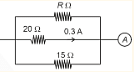 The ammeter reads 0.9 A. Value of R is
- JEE Main - 2024
- Physics
- Amperes circuital law
- A transistor is used in an amplifier circuit in common emitter mode. If the base current changes by 100μA, it brings a change of 10mA in collector current. If the load resistance is 2kΩ and input resistance is 1kΩ, the value of power gain is \(x×10^4\). The value of x is _______.
- JEE Main - 2022
- Physics
- Amperes circuital law
- Want to practice more? Try solving extra ecology questions todayView All Questions
