The figure represents the variation of the electric potential \( V \) at a point in a region of space as a function of its position along the x-axis. A charged particle will experience the maximum force at:
Show Hint
- P
- Q
- R
- S
The Correct Option is D
Approach Solution - 1
The problem involves finding the point where a charged particle experiences the maximum force based on the variation of electric potential along the x-axis.
The electric force experienced by a charged particle is related to the electric potential (V) by the electric field (E). The electric field is the negative gradient of the electric potential, represented mathematically as:
\(E = -\frac{dV}{dx}\)
The magnitude of the electric force (F) on a charged particle with charge \( q \) is given by:
\(F = qE\)
Therefore, the point at which the electric field is steepest (i.e., where the change in electric potential is steepest) corresponds to the point where the particle will experience the maximum force.
To determine the maximum force location from the provided graph, observe where the slope of \( V \) versus \( x \) is steepest. The slope at points \(P, Q, R,\) and \(S\) are examined:
- At point \(P\), the slope is not as steep.
- At point \(Q\), the slope decreases slightly.
- At point \(R\), the slope is moderate.
- At point \(S\), the slope is steepest among the considered points.
Therefore, the maximum change in potential, and hence maximum magnitude of electric field, occurs at point \(S\). Consequently, the charged particle will experience the maximum force at this point.
Correct Answer: \(S\)
Approach Solution -2
A helpful way to think about this is to picture the potential graph as a hill: the steeper the hill at a point, the harder a ball would be pushed there if it were rolling downhill. The electric force on a charge behaves the same way, since \( F = qE = -q\dfrac{dV}{dx} \), the steepest part of the \( V \) versus \( x \) curve produces the strongest push.
Scanning across the graph from P to S:
Around P and R, the curve runs level, like flat ground, there's no incline for the "ball" to roll down, so the electric field and the force are both zero at these points.
Around Q, there's a mild incline, enough to produce a small field and a modest force, but nowhere near the strongest point on the curve.
Around S, the curve climbs steeply in a short stretch, this is the steepest incline anywhere on the graph, so it produces the largest electric field magnitude and, with it, the largest force on the particle.
Since force tracks the steepness of the potential curve, and S is visibly the steepest region, the particle feels the greatest push there.
The correct answer is S.
Top Questions on Electric Potential And Potential Difference
- How is a voltmeter connected in the circuit to measure the potential difference between two points?
- CBSE Class X
- Science
- Electric Potential And Potential Difference
- A thin spherical shell is charged by some source. The potential difference between the two points C and P (in V) shown in the figure is:
(Take \(\frac{1}{4}\pi\epsilon_0 = 9 × 10⁹\)\(\frac{1}{4\pi\epsilon_0}=9\times10^9\) SI units)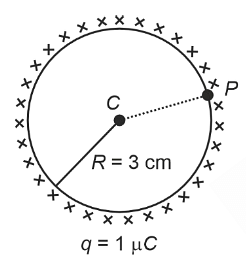
- NEET (UG) - 2024
- Physics
- Electric Potential And Potential Difference
- A charge of 10 coulomb is brought from infinity to a point \( P \) near a charged body and in this process 200 joules of work is done. Electric potential at point \( P \) is:
- JEECUP - 2024
- Physics
- Electric Potential And Potential Difference
Resistance of each side is $R$. Find equivalent resistance between two opposite points as shown in the figure.

- JEE Main - 2026
- Physics
- Electric Potential And Potential Difference
- Want to practice more? Try solving extra ecology questions todayView All Questions