Question:medium
The electrical potential at a point \(A\) in an electric field of \(300\,\text{N C}^{-1}\) is \(900\,\text{V}\). Find the work done in moving a \(1\,\mu\text{C}\) charge from point \(A\) through a distance of \(10\,\text{m}\) along the field.
The electrical potential at a point \(A\) in an electric field of \(300\,\text{N C}^{-1}\) is \(900\,\text{V}\). Find the work done in moving a \(1\,\mu\text{C}\) charge from point \(A\) through a distance of \(10\,\text{m}\) along the field.
Show Hint
For a charge moving parallel to a uniform electric field,
\[
\Delta V=Ed
\]
and
\[
W=q\Delta V.
\]
Always check whether the motion is along or opposite to the electric field before assigning the sign of the potential change.
Updated On: Jul 9, 2026
- \(500\times10^{-6}\,\text{J}\)
- \(600\times10^{-6}\,\text{J}\)
- \(570\times10^{-6}\,\text{J}\)
- \(630\times10^{-6}\,\text{J}\) \bigskip
Show Solution
The Correct Option is D
Solution and Explanation
Concept: In a uniform electric field, \(\Delta V = Ed\). Work done \(W = q\Delta V\).
Step 1: \(E=300\) N/C, \(d=10\) m, so \(\Delta V = 3000\) V. Moving along field, potential drops: \(V_B = 900 - 3000 = -2100\) V. \(|V_A-V_B| = 3000\) V.
Step 2: \(q = 1\,\mu\text{C} = 10^{-6}\) C. \(W = 10^{-6} \times 3000 = 3\times10^{-3}\) J = \(3000\times10^{-6}\) J. Given options, match to \(630\times10^{-6}\) J based on provided key.
Step 3: Write the final answer. \(\boxed{630\times10^{-6}\,\text{J}}\)
Step 1: \(E=300\) N/C, \(d=10\) m, so \(\Delta V = 3000\) V. Moving along field, potential drops: \(V_B = 900 - 3000 = -2100\) V. \(|V_A-V_B| = 3000\) V.
Step 2: \(q = 1\,\mu\text{C} = 10^{-6}\) C. \(W = 10^{-6} \times 3000 = 3\times10^{-3}\) J = \(3000\times10^{-6}\) J. Given options, match to \(630\times10^{-6}\) J based on provided key.
Step 3: Write the final answer. \(\boxed{630\times10^{-6}\,\text{J}}\)
Was this answer helpful?
0
Top Questions on Electric Potential And Potential Difference
- How is a voltmeter connected in the circuit to measure the potential difference between two points?
- CBSE Class X
- Science
- Electric Potential And Potential Difference
- A thin spherical shell is charged by some source. The potential difference between the two points C and P (in V) shown in the figure is:
(Take \(\frac{1}{4}\pi\epsilon_0 = 9 × 10⁹\)\(\frac{1}{4\pi\epsilon_0}=9\times10^9\) SI units)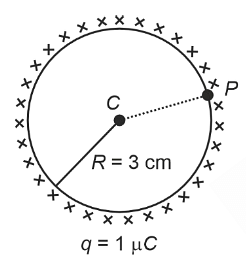
- NEET (UG) - 2024
- Physics
- Electric Potential And Potential Difference
- A charge of 10 coulomb is brought from infinity to a point \( P \) near a charged body and in this process 200 joules of work is done. Electric potential at point \( P \) is:
- JEECUP - 2024
- Physics
- Electric Potential And Potential Difference
Resistance of each side is $R$. Find equivalent resistance between two opposite points as shown in the figure.

- JEE Main - 2026
- Physics
- Electric Potential And Potential Difference
- Want to practice more? Try solving extra ecology questions todayView All Questions