The electric resistance of a certain wire of iron is R. If its length and radius are both doubled then
The resistance will be halved and the specific resistance will remain unchanged
The resistance will be halved and the specific resistance will be doubled
The resistance and the specific resistance, will both remain unchanged
The resistance will be doubled and the specific resistance will be halved
The Correct Option is A
Solution and Explanation
To solve the problem, we need to understand how the resistance of a wire changes with its physical dimensions, namely its length and radius.
The resistance R of a wire is given by the formula:
R = \rho \frac{L}{A}
where:
- \rho is the resistivity (also called specific resistance),
- L is the length of the wire,
- A is the cross-sectional area of the wire.
The cross-sectional area A of a wire with radius r is given by A = \pi r^2.
Let's analyze how the resistance changes when both the length and radius of the wire are doubled:
- If the length is doubled, L\_2 = 2L.
- If the radius is doubled, the new radius r\_2 = 2r, and the new cross-sectional area becomes: A\_2 = \pi (2r)^2 = 4\pi r^2 = 4A.
- Substituting the new length and area, the new resistance R\_2 will be: \[ R\_2 = \rho \frac{L\_2}{A\_2} = \rho \frac{2L}{4A} = \frac{1}{2}\rho \frac{L}{A} = \frac{R}{2} \] Hence, the resistance is halved.
Now, about the specific resistance, also known as resistivity (\rho):
- The specific resistance is a material property and remains unchanged under changes to the physical dimensions of the wire, such as length and radius.
Thus, the correct option is: The resistance will be halved and the specific resistance will remain unchanged.
Top Questions on Electric Potential And Potential Difference
- How is a voltmeter connected in the circuit to measure the potential difference between two points?
- CBSE Class X
- Science
- Electric Potential And Potential Difference
- A thin spherical shell is charged by some source. The potential difference between the two points C and P (in V) shown in the figure is:
(Take \(\frac{1}{4}\pi\epsilon_0 = 9 × 10⁹\)\(\frac{1}{4\pi\epsilon_0}=9\times10^9\) SI units)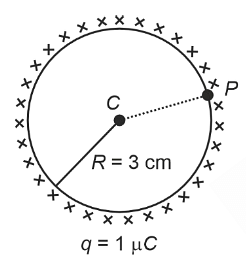
- NEET (UG) - 2024
- Physics
- Electric Potential And Potential Difference
- A charge of 10 coulomb is brought from infinity to a point \( P \) near a charged body and in this process 200 joules of work is done. Electric potential at point \( P \) is:
- JEECUP - 2024
- Physics
- Electric Potential And Potential Difference
Resistance of each side is $R$. Find equivalent resistance between two opposite points as shown in the figure.

- JEE Main - 2026
- Physics
- Electric Potential And Potential Difference
- Want to practice more? Try solving extra ecology questions todayView All Questions

