The elastic behavior of material for linear stress and linear strain, is shown in the figure. The energy density for a linear strain of 5×10⁻⁴ is ____ kJ/m3. Assume that material is elastic up to the linear strain of 5×10⁻⁴
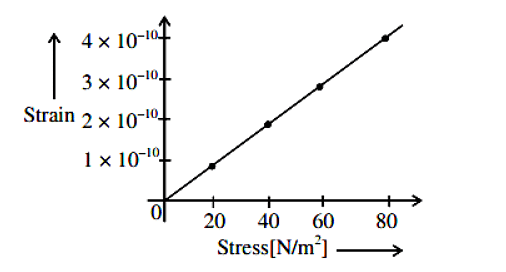
The elastic behavior of material for linear stress and linear strain, is shown in the figure. The energy density for a linear strain of 5×10⁻⁴ is ____ kJ/m3. Assume that material is elastic up to the linear strain of 5×10⁻⁴
Correct Answer: 25
Solution and Explanation
To find the energy density for a linear strain of \(5 \times 10^{-4}\), we use the formula for elastic energy density:
\( \text{Energy Density} = \frac{1}{2} \sigma \epsilon \)
Where \(\sigma\) is the stress and \(\epsilon\) is the strain.
From the graph, the material follows a linear stress-strain relationship, meaning \(\sigma = E \cdot \epsilon\), where \(E\) is the Young's modulus.
We find \(E\) using the slope of the line, \(\frac{\Delta \sigma}{\Delta \epsilon} = \frac{80 \, \text{N/m}^2}{4 \times 10^{-10}}\). Calculating:
\(E = \frac{80}{4 \times 10^{-10}} = 2 \times 10^{11} \, \text{N/m}^2\)
Substituting \(\sigma = E \cdot \epsilon\) and the given \(\epsilon = 5 \times 10^{-4}\):
\(\sigma = 2 \times 10^{11} \times 5 \times 10^{-4} = 1 \times 10^8 \, \text{N/m}^2\)
Now, calculate the energy density:
\(\text{Energy Density} = \frac{1}{2} \times 1 \times 10^8 \times 5 \times 10^{-4}\)
\(= 2.5 \times 10^4 \, \text{J/m}^3 = 25 \, \text{kJ/m}^3\)
The energy density is \(25 \, \text{kJ/m}^3\), which is within the provided range (25, 25).
Top Questions on elastic moduli
A steel wire of length 4.7 m and cross-sectional area 3.0 × 10⁻⁵ m2 stretches by the same amount as a copper wire of length 3.5 m and cross-sectional area of 4.0 × 10⁻⁵ m2 under a given load. What is the ratio of the Young’s modulus of steel to that of copper?
- CBSE Class XI
- Physics
- elastic moduli
- How much should the pressure on a litre of water be changed to compress it by 0.10%? carry one quarter of the load.
- CBSE Class XI
- Physics
- elastic moduli
Two wires of diameter 0.25 cm, one made of steel and the other made of brass are loaded as shown in Fig. 8.11. The unloaded length of steel wire is 1.5 m and that of brass wire is 1.0 m. Compute the elongations of the steel and the brass wires.

- CBSE Class XI
- Physics
- elastic moduli
Read the following two statements below carefully and state, with reasons, if it is true or false.
(a) The Young’s modulus of rubber is greater than that of steel;
(b) The stretching of a coil is determined by its shear modulus.
- CBSE Class XI
- Physics
- elastic moduli
- Want to practice more? Try solving extra ecology questions todayView All Questions
