Nucleotides are joined together by:
Nucleotides are joined together by:
Show Hint
- Glycosidic linkage
- Peptide linkage
- Hydrogen bonding
- Phosphodiester linkage
The Correct Option is D
Solution and Explanation
To resolve this issue, we must ascertain the mechanism by which nucleotides connect within a biological framework.
1. Nucleotide Composition:
Nucleotides serve as the fundamental units of nucleic acids, including DNA and RNA. Each nucleotide comprises a sugar moiety, a phosphate group, and a nitrogenous base.
2. Bond Identification:
Within nucleic acids, nucleotides link sequentially to form a polynucleotide strand. The linkage between nucleotides occurs via a bond formed between the phosphate group of one nucleotide and the sugar component (specifically, the 3’ hydroxyl group) of the subsequent nucleotide. This covalent linkage is termed a phosphodiester bond, establishing the sugar-phosphate backbone characteristic of DNA and RNA.
3. Specificity Confirmation:
The phosphodiester bond is exclusively involved in the covalent connection of nucleotides within a single nucleic acid strand. While other bond types, such as hydrogen bonds, facilitate base pairing between complementary strands, this inquiry pertains to the intrastrand nucleotide linkage.
Conclusion:
The covalent linkage uniting nucleotides is the phosphodiester bond.
Top Questions on Nucleic Acids
- Identify the polarity from ‘X’ to ‘Y’ in the mRNA segment shown. Mention how many more amino acids can be added to the polypeptide that is being translated and why.
- CBSE Class XII - 2024
- Biology
- Nucleic Acids
- Assertion (A): Uracil base is present in DNA. Reason (R): DNA undergoes self-replication.
- CBSE Class XII - 2024
- Chemistry
- Nucleic Acids
- Two nucleotides are joined together by a linkage known as:
- JEE Main - 2024
- Chemistry
- Nucleic Acids
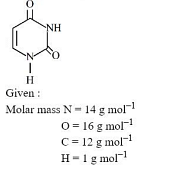
- Uracil is a base present in RNA with the following structure $\%$ of $N$ in uracil is ___
- JEE Main - 2023
- Chemistry
- Nucleic Acids
- Want to practice more? Try solving extra ecology questions todayView All Questions