Mr. Seth inherits 2505 gold coins and divides them among his three sons: Brij,Purab and Mohan in a certain ratio.Out of the total coins received by each of them,Brij sells 30 coins,Purab donates his 30 coins and Mohan looses 25 coins.Now,the ratio of gold coins with them is 46: 41: 34 respectively.How many coins did Purab receive from his father?
- 705
- 950
- 800
- 850
The Correct Option is D
Solution and Explanation
Let the coin counts for Brij, Purab, and Mohan be \( x \), \( y \), and \( z \), respectively. The total number of coins is 2505:
\[ x + y + z = 2505 \]
After transactions: Brij sells 30 coins, Purab donates 30, and Mohan loses 25. The remaining coin counts and their ratio are:
\[ \frac{x - 30}{y - 30} = \frac{46}{41}, \quad \frac{y - 30}{z - 25} = \frac{41}{34} \]
Step 1: First Ratio
From the first ratio:
\[ \frac{x - 30}{y - 30} = \frac{46}{41} \]
Cross-multiplying:
\[ 41(x - 30) = 46(y - 30) \]
Simplifying:
\[ 41x - 1230 = 46y - 1380 \]
\[ 41x - 46y = -150 \]
Equation (1).
Step 2: Second Ratio
From the second ratio:
\[ \frac{y - 30}{z - 25} = \frac{41}{34} \]
Cross-multiplying:
\[ 34(y - 30) = 41(z - 25) \]
Simplifying:
\[ 34y - 1020 = 41z - 1025 \]
\[ 34y - 41z = -5 \]
Equation (2).
Step 3: Solving the System
System of equations:
\[ 41x - 46y = -150 \quad \text{(1)} \]
\[ 34y - 41z = -5 \quad \text{(2)} \]
From equation (1), solve for \( x \):
\[ x = \frac{46y - 150}{41} \]
Substitute into the total coins equation:
\[ \frac{46y - 150}{41} + y + z = 2505 \]
Multiply by 41:
\[ 46y - 150 + 41y + 41z = 2505 \times 41 \]
Simplify:
\[ 87y + 41z = 102855 \]
From equation (2), express \( z \) in terms of \( y \):
\[ 41z = 34y + 5 \quad \Rightarrow \quad z = \frac{34y + 5}{41} \]
Substitute \( z \) into \( 87y + 41z = 102855 \):
\[ 87y + 41\left(\frac{34y + 5}{41}\right) = 102855 \]
Simplify:
\[ 87y + 34y + 5 = 102855 \]
\[ 121y + 5 = 102855 \]
Subtract 5:
\[ 121y = 102850 \]
Solve for \( y \):
\[ y = \frac{102850}{121} = 850 \]
Thus, Purab received 850 coins.
Top Questions on Ratio and Proportion
- There are 187 fruits in total. The ratio of apples to mangoes is \(2 : 3\), and the rest are oranges. After selling 67 apples, 26 mangoes, and half of the oranges, the ratio of the remaining apples to oranges becomes \(1 : 2\). Determine how many unsold fruits remain.
- CAT - 2024
- Quantitative Aptitude
- Ratio and Proportion
- A mixture P is formed by removing a certain amount of coffee from a coffee jar and replacing the same amount with cocoa powder and the same amount is again removed from P and replaced with the same amount of cocoa powder to form a mixture Q. If the ratio of coffee and cocoa in Q=16:9. Then the ratio of coca in with P:Q is?
- CAT - 2023
- Quantitative Aptitude
- Ratio and Proportion
- In a company, 20% of the employees work in the manufacturing department. If the total salary obtained by all the manufacturing employees is one-sixth of the total salary obtained by all the employees in the company, then the ratio of the average salary obtained by the manufacturing employees to the average salary obtained by the non-manufacturing employees is
- CAT - 2023
- Quantitative Aptitude
- Ratio and Proportion
- If a certain amount of money is divided equally among n persons, each one receives Rs 352 . However, if two persons receive Rs 506 each and the remaining amount is divided equally among the other persons, each of them receive less than or equal to Rs 330 . Then, the maximum possible value of n is
- CAT - 2023
- Quantitative Aptitude
- Ratio and Proportion
- Want to practice more? Try solving extra ecology questions todayView All Questions
Questions Asked in CMAT exam
| Store | Respective ratio of number of linen kurtis to cotton kurtis sold |
| A | 7:5 |
| B | 5:6 |
| C | 3:2 |
| D | 5:3 |
| E | 4:3 |
| F | 7:3 |
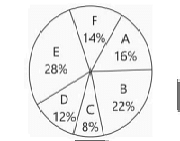
What is the difference between average number of linen kurtis sold by stores D and E together and average number of cotton kurtis sold by the same stores together?
- CMAT - 2024
- Pie Charts