Question:medium
A and B bought lands on the Moon from an eStore, both with the same diameter but A’s land is square-shaped, and B’s land is circular. What is the ratio of the areas of their respective lands?
A and B bought lands on the Moon from an eStore, both with the same diameter but A’s land is square-shaped, and B’s land is circular. What is the ratio of the areas of their respective lands?
Show Hint
For shapes with the same diameter, the square will always have a larger area than the circle because a square’s corners extend beyond the circle’s boundary. This holds for any diameter comparison.
Updated On: Jul 15, 2026
- 4 : π
- π : 4
- 1 : π
- π : 1
Show Solution
The Correct Option is A
Solution and Explanation
The square and the circle share an identical diameter, denoted as \(d\).
Area of the square land: The side length of the square is equal to its diameter \(d\). The area of the square is \(d^2\).
Area of the circular land: The area of a circle is calculated as \(\pi r^2\), where \(r\) is the radius. Given that the radius \(r = \frac{d}{2}\), the area of the circle is \(\pi \left(\frac{d}{2}\right)^2 = \frac{\pi d^2}{4}\).
Ratio of Areas:
\[ \text{Ratio} = \frac{\text{Area of square}}{\text{Area of circle}} = \frac{d^2}{\frac{\pi d^2}{4}} = \frac{4}{\pi}. \]
Consequently, the ratio of their areas is \(4 : \pi\).
Was this answer helpful?
0
Top Questions on Ratio and Proportion
- There are 187 fruits in total. The ratio of apples to mangoes is \(2 : 3\), and the rest are oranges. After selling 67 apples, 26 mangoes, and half of the oranges, the ratio of the remaining apples to oranges becomes \(1 : 2\). Determine how many unsold fruits remain.
- CAT - 2024
- Quantitative Aptitude
- Ratio and Proportion
- A mixture P is formed by removing a certain amount of coffee from a coffee jar and replacing the same amount with cocoa powder and the same amount is again removed from P and replaced with the same amount of cocoa powder to form a mixture Q. If the ratio of coffee and cocoa in Q=16:9. Then the ratio of coca in with P:Q is?
- CAT - 2023
- Quantitative Aptitude
- Ratio and Proportion
- In a company, 20% of the employees work in the manufacturing department. If the total salary obtained by all the manufacturing employees is one-sixth of the total salary obtained by all the employees in the company, then the ratio of the average salary obtained by the manufacturing employees to the average salary obtained by the non-manufacturing employees is
- CAT - 2023
- Quantitative Aptitude
- Ratio and Proportion
- If a certain amount of money is divided equally among n persons, each one receives Rs 352 . However, if two persons receive Rs 506 each and the remaining amount is divided equally among the other persons, each of them receive less than or equal to Rs 330 . Then, the maximum possible value of n is
- CAT - 2023
- Quantitative Aptitude
- Ratio and Proportion
- Want to practice more? Try solving extra ecology questions todayView All Questions
Questions Asked in XAT exam
Applicants have been shortlisted for interviews for some data analyst positions. Some of the applicants have advanced expertise in one or more fields among the following: data analysis, database handling and coding. The numbers of applicants with different advanced expertise are given in the 2 × 8 table below.
The number of applicants with advanced expertise in all three fields is given as x in the table, where x is a non-negative integer.
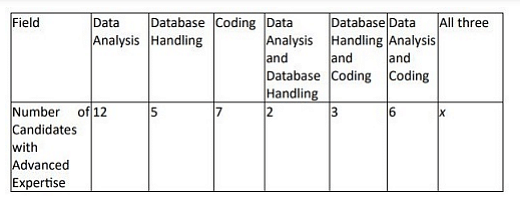
The number of applicants with advanced expertise in all three fields is given as x in the table, where x is a non-negative integer.
- XAT - 2024
- Data Interpretation