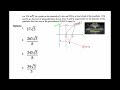
Let \( P(4, 4\sqrt{3}) \) be a point on the parabola \( y^2 = 4ax \) and PQ be a focal chord of the parabola. If M and N are the foot of the perpendiculars drawn from P and Q respectively on the directrix of the parabola, then the area of the quadrilateral PQMN is equal to:
Show Hint
- \( \frac{343\sqrt{3}}{8} \)
- \( \frac{343\sqrt{3}}{8} \)
- \( \frac{34\sqrt{3}}{3} \)
- \( 17\sqrt{3} \)
The Correct Option is A
Solution and Explanation
Given that the point \( (4, 4\sqrt{3}) \) satisfies the equation \( y^2 = 4ax \), we substitute the coordinates: \( (4\sqrt{3})^2 = 4a(4) \). This simplifies to \( 48 = 16a \), which yields \( 4a = 12 \). Consequently, the equation of the parabola is \( y^2 = 12x \). The parameter for point \( P \) is given as \( t_1 = \frac{2}{\sqrt{3}} \). For point \( Q \), the parameter is \( t_2 = -\frac{\sqrt{3}}{2} \), resulting in the coordinates \( \left( \frac{9}{4}, -3\sqrt{3} \right) \). \textbf{The area of trapezium PQNM is calculated as follows:} \[ \text{Area} = \frac{1}{2} \times MN \times (PM + QN) \] This can be expressed as: \[ \text{Area} = \frac{1}{2} \times MN \times (PS + QS) \] Further simplification leads to: \[ \text{Area} = \frac{1}{2} \times MN \times PQ \] Substituting the known values: \[ \text{Area} = \frac{1}{2} \times 7\sqrt{3} \times \frac{49}{4} \] The final area is: \[ \text{Area} = \frac{343\sqrt{3}}{8} \]
Learn with videos:
Top Questions on Parabola
- Find the area of the region bounded by the parabola $$ y^2 = 4ax \text{ and its latus rectum.} $$
- MHT CET - 2024
- Mathematics
- Parabola
- If the focus of the parabola \[ (y - k)^2 = 4(x - h) \] always lies between the lines \(x + y = 1\) and \(x + y = 3\) then:
- BITSAT - 2024
- Mathematics
- Parabola
- Let \(L_1\) be the length of the common chord of the curves \[ x^2 + y^2 = 9 \quad {and} \quad y^2 = 8x \] and let \(L_2\) be the length of the latus rectum of \(y^2 = 8x\). Then:
- BITSAT - 2024
- Mathematics
- Parabola
- \((α, β)\) lie on the parabola \(y^2 = 4x\) and \((α, β)\) also lie on chord with midpoint \((1,\frac 54)\) of another parabola \(x^2 = 8y\), then value of \(|(8 – β)(α – 28)|\) is
- JEE Main - 2024
- Mathematics
- Parabola
- Want to practice more? Try solving extra ecology questions todayView All Questions
