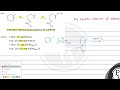
Step 1: Ozonolysis (compound A formation): Ozonolysis of the cycloalkene's double bond using ozone (\( \text{O}_3 \)) followed by Zn/\( \text{H}_2\text{O} \) reduction cleaves the double bond. This results in two aldehyde groups on adjacent carbons. 2. Step 2: Haloform reaction (compound B formation): Compound A's aldehyde (or ketone) reacts with \( \text{NaOH}_{(\text{alc})} \) and \( \text{I}_2 \). This cleaves the terminal methyl ketone or aldehyde, yielding sodium formate (\( \text{HCOONa} \)) and iodoform (\( \text{CHI}_3 \)), and leaving a carboxylic acid group. Compound B, the final product, has a carboxylate ion (\( \text{COO}^- \)) and a secondary alcohol group. The complete mechanism facilitates the conversion of "A" to "B."