In an office with 8 employees, the average rating of all employees is 30. The average rating of the top five employees is 38, and the average rating of the bottom three employees is 25. Which of the following is not possible?
Show Hint
- One of the top five employees has a rating of 50.
- The lowest rating among the bottom three employees is 20.
- The highest rating among the top five employees is 40.
- One of the bottom three employees has a rating of 24.
The Correct Option is C
Solution and Explanation
Total Ratings:
Total ratings for all employees:
\[ \text{Total} = 8 \times 30 = 240 \]
Top Five and Bottom Three Totals:
Total ratings for the top five employees:
\[ \text{Top Five Total} = 5 \times 38 = 190 \]
Total ratings for the bottom three employees:
\[ \text{Bottom Three Total} = 3 \times 25 = 75 \]
Verification of Totals:
Sum of ratings for all employees:
\[ \text{Sum of Top Five + Bottom Three} = 190 + 75 = 265 \]
This sum (265) exceeds the calculated total ratings of 240, indicating a discrepancy.
Analyze the Options:
(A) One of the top five employees has a rating of 50:
If one top employee's rating is 50, the remaining total for the other four is:
\[ 190 - 50 = 140, \quad \text{Average for four} = \frac{140}{4} = 35 \]
This scenario is plausible, as the remaining ratings are consistent with the data.
(B) The lowest rating among the bottom three employees is 20:
If one bottom employee's rating is 20, the remaining total for the other two is:
\[ 75 - 20 = 55, \quad \text{Average for two} = \frac{55}{2} = 27.5 \]
This scenario is plausible, as the calculated averages are consistent.
(C) The highest rating among the top five employees is 40:
If the highest rating among the top five is 40, the remaining total for the other four is:
\[ 190 - 40 = 150, \quad \text{Average for four} = \frac{150}{4} = 37.5 \]
This contradicts the given average of 38 for the top five, rendering this scenario impossible.
(D) One of the bottom three employees has a rating of 24:
If one bottom employee's rating is 24, the remaining total for the other two is:
\[ 75 - 24 = 51, \quad \text{Average for two} = \frac{51}{2} = 25.5 \]
This scenario is plausible, as it meets the stated conditions.
Thus, the correct answer is (C).
Top Questions on Average
- A person brought a load of bags towards a weighing machine and measured the weights of the bags in a particular order. First, he weighed three bags individually, then weighed the bags taking two at a time of different combinations and lastly weighed all the three bags at a time. The recorded weight for the last measure was 203 kg. What is the average of the 7 measurers he has taken?
- IBSAT
- Quantitative Aptitude
- Average
- The total age of a group of 20 children is 160 years. If the average age of 8 of the children of the group is 12 years, find the average age of the remaining group.
- IBSAT
- Quantitative Aptitude
- Average
- Average monthly expenditure for January--June is ₹ 3200. He spends ₹ 3000 (July), ₹ 3600 (Aug), ₹ 3900 (Sept), ₹ 4200 (Oct). If November’s expenditure is $50%$ of December’s and the average for the entire year is ₹ 3200, find November’s expenditure.
- If the average of p numbers is q2 and that of q numbers is p2, then the average of (p+q) numbers is:
- Want to practice more? Try solving extra ecology questions todayView All Questions
Questions Asked in XAT exam
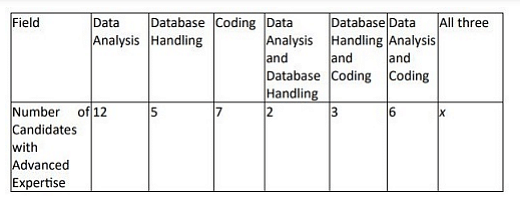
The number of applicants with advanced expertise in all three fields is given as x in the table, where x is a non-negative integer.
- XAT - 2024
- Data Interpretation