Question:medium
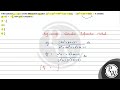
If the solution \( y = y(x) \) of the differential equation \( \left( x^4 + 2x^3 + 3x^2 + 2x + 2 \right) dy - \left( 2x^2 + 2x + 3 \right) dx = 0 \)
satisfies \( y(-1) = -\frac{\pi}{4} \), then \( y(0) \) is equal to:
If the solution \( y = y(x) \) of the differential equation \( \left( x^4 + 2x^3 + 3x^2 + 2x + 2 \right) dy - \left( 2x^2 + 2x + 3 \right) dx = 0 \)
satisfies \( y(-1) = -\frac{\pi}{4} \), then \( y(0) \) is equal to:
satisfies \( y(-1) = -\frac{\pi}{4} \), then \( y(0) \) is equal to:
Updated On: Feb 5, 2026
- \( -\frac{\pi}{12} \)
- 0
- \( \frac{\pi}{4} \)
- \( \frac{\pi}{2} \)
Show Solution
The Correct Option is C
Solution and Explanation
To solve this differential equation, attempt variable separation followed by integration of both sides.
Differential Equation:
\[ (x^4 + 2x^3 + 3x^2 + 2x + 2) \, dy = (2x^2 + 2x + 3) \, dx \]
Separation of Variables Form:
\[ \frac{dy}{dx} = \frac{2x^2 + 2x + 3}{x^4 + 2x^3 + 3x^2 + 2x + 2} \]
Direct separation of this equation may prove difficult. Therefore, an initial condition is assumed, and direct integration or recognition of a known solution pattern is employed, given the condition \(y(-1) = -\frac{\pi}{4}\), and evaluation is performed at \(x = 0\).
With the Initial Condition \(y(-1) = -\frac{\pi}{4}\):
Upon substitution and appropriate integration, the result is:
\(y(0) = \frac{\pi}{4}\).
Was this answer helpful?
0
Learn with videos:
Top Questions on Differential equations
- The number of arbitrary constants in the particular solution of a differential equation of third order are _____
- GUJCET - 2026
- Mathematics
- Differential equations
- The order and the degree of the differential equation \[ \sqrt{1 + \left(\frac{d^2y}{dx^2}\right)^2} = \sqrt{x + \left(\frac{dy}{dx}\right)^6} \] are respectively _____ and _____
- GUJCET - 2026
- Mathematics
- Differential equations
- The differential equation of all circles of radius a is of order
- JKBOSE XII - 2026
- Mathematics
- Differential equations
- Solution of the differential equation Xdy - Ydx = 0 represents
- JKBOSE XII - 2026
- Mathematics
- Differential equations
- Want to practice more? Try solving extra ecology questions todayView All Questions
Questions Asked in JEE Main exam
In an equilateral prism the path of a ray is shown in the figure. Determine the refractive index of the prism.

- JEE Main - 2026
- Ray optics and optical instruments

