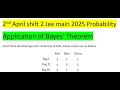
Given three identical bags each containing 10 balls, whose colours are as follows:
Bag I 3 Red 2 Blue 5 Green Bag II 4 Red 3 Blue 3 Green Bag III 5 Red 1 Blue 4 Green
A person chooses a bag at random and takes out a ball. If the ball is Red, the probability that it is from Bag I is $ p $ and if the ball is Green, the probability that it is from Bag III is $ q $, then the value of $ \frac{1}{p} + \frac{1}{q} $ is:
Given three identical bags each containing 10 balls, whose colours are as follows:
| Bag I | 3 Red | 2 Blue | 5 Green |
| Bag II | 4 Red | 3 Blue | 3 Green |
| Bag III | 5 Red | 1 Blue | 4 Green |
A person chooses a bag at random and takes out a ball. If the ball is Red, the probability that it is from Bag I is $ p $ and if the ball is Green, the probability that it is from Bag III is $ q $, then the value of $ \frac{1}{p} + \frac{1}{q} $ is:
Show Hint
- 6
- 9
- 7
- 8
The Correct Option is C
Solution and Explanation
Bag I: \( 3R, 2B, 5G \) Bag II: \( 4R, 3B, 3G \) Bag III: \( 5R, 1B, 4G \)
Calculate \( p \) and \( q \). The probability \( p \), representing the ratio of blue balls to red balls, is calculated as \( p = P\left( \frac{B_1}{R} \right) = \frac{\frac{3}{10}}{\frac{3}{10} + \frac{4}{10} + \frac{5}{10}} = \frac{1}{4} \). The probability \( q \), representing the ratio of blue balls from Bag III to green balls, is calculated as \( q = P\left( \frac{B_3}{G} \right) = \frac{\frac{4}{10}}{\frac{5}{10} + \frac{3}{10} + \frac{4}{10}} = \frac{1}{3} \). Therefore, the sum of the reciprocals is \( \frac{1}{p} + \frac{1}{q} = 7 \).
Learn with videos:
Top Questions on Conditional Probability
- If \( P(A|B) = P(A'|B) \), then which of the following statements is true?
- CBSE Class XII - 2024
- Mathematics
- Conditional Probability
A gardener wanted to plant vegetables in his garden. Hence he bought 10 seeds of brinjal plant, 12 seeds of cabbage plant, and 8 seeds of radish plant. The shopkeeper assured him of germination probabilities of brinjal, cabbage, and radish to be 25%, 35%, and 40% respectively. But before he could plant the seeds, they got mixed up in the bag and he had to sow them randomly.
 What is the probability that it is a cabbage seed, given that the chosen seed germinates?
- CBSE Class XII - 2025
- Mathematics
- Conditional Probability
- Probability of event A is 0.7 and event B is 0.4, and $ P(A \cap B^c) = 0.5 $, then the value of $ P(B | A \cup B^c) $ is equal to:
- JEE Main - 2025
- Mathematics
- Conditional Probability
- A bag contains 19 unbiased coins and one coin with heads on both sides. One coin is drawn at random and tossed, and heads turns up. If the probability that the drawn coin was unbiased is $ \frac{m}{n} $, where $ \gcd(m, n) = 1 $, then $ n^2 - m^2 $ is equal to:
- JEE Main - 2025
- Mathematics
- Conditional Probability
- Want to practice more? Try solving extra ecology questions todayView All Questions
