Question:medium
G2L2 woman delivered at home by a trained dai presents with uterine prolapse. Which structure is weak?
G2L2 woman delivered at home by a trained dai presents with uterine prolapse. Which structure is weak?
Show Hint
For uterine prolapse, remember the key support: cardinal ligament.
Updated On: Aug 27, 2026
- Round ligament
- Broad ligament
- Cardinal ligament
- Uterosacral ligament
Show Solution
The Correct Option is C
Solution and Explanation
Step 1: Understanding the Question:
The patient has Pelvic Organ Prolapse (uterine prolapse) following multiple deliveries. We need to identify the primary anatomical support of the uterus that has failed.
Step 2: Detailed Explanation:
Pelvic Supports: The uterus is held in place by a combination of pelvic floor muscles (the levator ani) and several ligaments.
Cardinal Ligament (Mackenrodt's): These are the transverse cervical ligaments. They extend from the side of the cervix and lateral vaginal vault to the lateral pelvic wall. They provide the primary lateral support and are considered the most important ligaments for preventing the uterus from descending into the vagina.
Uterosacral Ligaments (D): These provide posterior support, pulling the cervix backward and keeping the uterus in an anteverted position. Their weakness also contributes to prolapse.
Ligaments with minimal support:
- Round Ligament (A): Keeps the uterus anteverted but provides almost no structural support against gravity.
- Broad Ligament (B): A fold of peritoneum that carries vessels but does not provide significant mechanical support.
Clinical Correlation: In women with multiple vaginal deliveries (G2L2), especially those with poor obstetric care (delivered by "dai" without proper perineal support), the cardinal and uterosacral ligaments can become stretched and weakened, leading to prolapse.
Step 3: Final Answer:
The Cardinal ligament is the principal structural support of the uterus, and its weakness is the main factor in uterine descent.
The patient has Pelvic Organ Prolapse (uterine prolapse) following multiple deliveries. We need to identify the primary anatomical support of the uterus that has failed.
Step 2: Detailed Explanation:
Pelvic Supports: The uterus is held in place by a combination of pelvic floor muscles (the levator ani) and several ligaments.
Cardinal Ligament (Mackenrodt's): These are the transverse cervical ligaments. They extend from the side of the cervix and lateral vaginal vault to the lateral pelvic wall. They provide the primary lateral support and are considered the most important ligaments for preventing the uterus from descending into the vagina.
Uterosacral Ligaments (D): These provide posterior support, pulling the cervix backward and keeping the uterus in an anteverted position. Their weakness also contributes to prolapse.
Ligaments with minimal support:
- Round Ligament (A): Keeps the uterus anteverted but provides almost no structural support against gravity.
- Broad Ligament (B): A fold of peritoneum that carries vessels but does not provide significant mechanical support.
Clinical Correlation: In women with multiple vaginal deliveries (G2L2), especially those with poor obstetric care (delivered by "dai" without proper perineal support), the cardinal and uterosacral ligaments can become stretched and weakened, leading to prolapse.
Step 3: Final Answer:
The Cardinal ligament is the principal structural support of the uterus, and its weakness is the main factor in uterine descent.
Was this answer helpful?
0
Top Questions on Urogenital Systems
- 60 year woman comes with 3rd degree uterine prolapse. What will be the management?
- NEET (PG) - 2019
- Gynaecology and Obstetrics
- Urogenital Systems
- The major contribution of the amniotic fluid after 20 weeks of gestation :
- NEET (PG) - 2019
- Gynaecology and Obstetrics
- Urogenital Systems
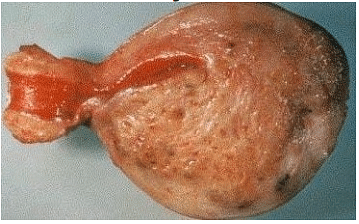
- 30 year old woman with complaint of dysmenorrhoea, dyspareunia with chronic pelvic pain undergoes hysterectomy. From the cut section of hysterectomy specimen below identify the condition.
- NEET (PG) - 2019
- Gynaecology and Obstetrics
- Urogenital Systems
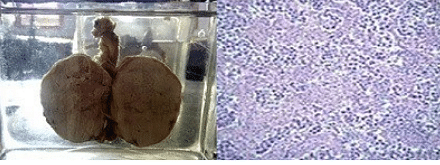
- Identify the condition represented in the image.
- NEET (PG) - 2017
- Gynaecology and Obstetrics
- Urogenital Systems
- Want to practice more? Try solving extra ecology questions todayView All Questions


