Question:medium
For all real numbers $ x $, the condition $ |3x - 20| + |3x - 40| = 20 $ necessarily holds if
For all real numbers $ x $, the condition $ |3x - 20| + |3x - 40| = 20 $ necessarily holds if
Updated On: Sep 23, 2026
\(6 < x < 11\)
\(7 < x < 12\)
\(10 < x < 15\)
\(9 < x < 14\)
Show Solution
The Correct Option is B
Solution and Explanation
The minimum value of the modulus function is zero. For the expression \(|3x - 20| + |3x - 40| = 20\), the minimum value for \(|3x - 20|\) occurs at \(x = \frac{20}{3}\), and the minimum value for \(|3x - 40|\) occurs at \(x = \frac{40}{3}\).
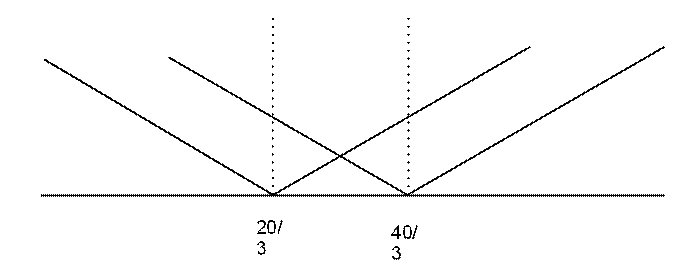
Consider the equation:
\[ |3x - 20| + |3x - 40| = 20 \]
Function Behavior:
- When \( x < \frac{20}{3} \), both \(3x - 20\) and \(3x - 40\) are negative. As \(x\) increases, their absolute values decrease, and thus their sum decreases.
- When \( x > \frac{40}{3} \), both \(3x - 20\) and \(3x - 40\) are positive. As \(x\) increases, their absolute values increase, and thus their sum increases.
- In the interval \( \left[ \frac{20}{3}, \frac{40}{3} \right] \), \(3x - 20 \geq 0\) and \(3x - 40 \leq 0\). The expression becomes \((3x - 20) + -(3x - 40) = 3x - 20 - 3x + 40 = 20\).
This implies:
\[ \text{The sum is constant at 20 for } x \in \left[ \frac{20}{3}, \frac{40}{3} \right] \Rightarrow x \in [6.66, 13.33] \]
Correct Option:
The interval that is entirely contained within the solution set \( \left[ \frac{20}{3}, \frac{40}{3} \right] \) is:
\( \boxed{(B)\ 7 < x < 12} \)
Was this answer helpful?
0
Top Questions on Inequalities & Modulus
- The number of integers \( n \) that satisfy the inequalities \( |n - 60| < |n - 100| < |n - 20| \) is
- CAT - 2021
- Quantitative Aptitude
- Inequalities & Modulus
- \(f(x) = \) \(\frac{x^2+2x−15}{x^2−7x−18}\) is negative if and only if
- CAT - 2021
- Quantitative Aptitude
- Inequalities & Modulus
- If r is a constant such that \(|x^2-4x-13| = r\) has exactly three distinct real roots, then the value of r is
- CAT - 2021
- Quantitative Aptitude
- Inequalities & Modulus
- For all possible integers n satisfying \(2.25 ≤ 2 + 2^{n + 2} ≤ 202\), the number of integer values of \(3 + 3^{n + 1}\) is
- CAT - 2021
- Quantitative Aptitude
- Inequalities & Modulus
- Want to practice more? Try solving extra ecology questions todayView All Questions