Question:medium
Calculate the λmax of the following molecule:
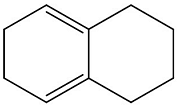
Calculate the λmax of the following molecule:
Updated On: Jul 14, 2026
- 283 nm
- 273 nm
- 234 nm
- 244 nm
Show Solution
The Correct Option is B
Solution and Explanation
Step 1: Identify the chromophore.
The molecule is a fused bicyclic ring system with two double bonds sitting in the same ring, one after another with a single bond between them. This makes it a conjugated diene that is locked in the s-cis form because it is held inside one ring, so it is classed as a homoannular diene.
Step 2: Pick the base value.
Woodward-Fieser rules give a base value of 253 nm for a homoannular diene (as opposed to 217 nm for a diene spread across two rings or an open chain).
\[ \text{Base value} = 253 \text{ nm} \]
Step 3: Add the substituent increments.
Each carbon of the diene system that carries a ring residue (an attached ring carbon acting like an alkyl group) adds +5 nm. In this bicyclic skeleton, the diene carbons carry four such ring residues, and there is no double bond that sits outside the ring it is drawn in, so no exocyclic increment is added.
\[ 4 \times 5 = 20 \text{ nm} \]
Step 4: Final Answer.
\[ \lambda_{max} = 253 + 20 = 273 \text{ nm} \]
\[ \boxed{273 \text{ nm}} \]
The molecule is a fused bicyclic ring system with two double bonds sitting in the same ring, one after another with a single bond between them. This makes it a conjugated diene that is locked in the s-cis form because it is held inside one ring, so it is classed as a homoannular diene.
Step 2: Pick the base value.
Woodward-Fieser rules give a base value of 253 nm for a homoannular diene (as opposed to 217 nm for a diene spread across two rings or an open chain).
\[ \text{Base value} = 253 \text{ nm} \]
Step 3: Add the substituent increments.
Each carbon of the diene system that carries a ring residue (an attached ring carbon acting like an alkyl group) adds +5 nm. In this bicyclic skeleton, the diene carbons carry four such ring residues, and there is no double bond that sits outside the ring it is drawn in, so no exocyclic increment is added.
\[ 4 \times 5 = 20 \text{ nm} \]
Step 4: Final Answer.
\[ \lambda_{max} = 253 + 20 = 273 \text{ nm} \]
\[ \boxed{273 \text{ nm}} \]
Was this answer helpful?
1
Top Questions on Nucleic acid: replication, transcription, splicing, translation
- Calculate the \( \lambda_{\text{max}} \) of the following molecule:
- GPAT - 2024
- Biochemistry
- Nucleic acid: replication, transcription, splicing, translation
- The RNA primer synthesized during bacterial DNA replication is removed by .
- GATE BT - 2026
- Genetics, Cellular and Molecular Biology
- Nucleic acid: replication, transcription, splicing, translation
- Want to practice more? Try solving extra ecology questions todayView All Questions