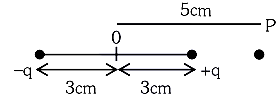
An electric dipole is placed as shown in the figure. The electric potential (in 102 V) at point P due to the dipole is (ε0 = permittivity of free space and \(\frac{1}{4\pi\epsilon_0}=K\)):
To find the electric potential at point \( P \) due to the dipole, we need to understand the configuration of the dipole and apply the formula for electric potential due to a dipole.
The electric potential \( V \) at a point due to a dipole is given by the formula:
\(V = \frac{q \cdot k \cdot \cos(\theta)}{r^2}\)
Where:
\( q \) is the charge of the dipole.
\( k \) is the Coulomb's constant \( \left(\frac{1}{4\pi\epsilon_0}\right) \).
\( r \) is the distance from the midpoint of the dipole to the point \( P \).
\( \theta \) is the angle between the dipole axis and the line joining the midpoint of the dipole and point \( P \). In this case, \( \theta = 0 \) as point \( P \) is on the axial line of the dipole.
From the figure, the distances are given as:
Distance between charges \( -q \) and \( +q \) is \( 6 \, \text{cm} \) (i.e., \( 0.06 \, \text{m} \)).
Distance from midpoint \( O \) of the dipole to point \( P \) is \( 5 \, \text{cm} \) (i.e., \( 0.05 \, \text{m} \)).
The total distance from the charge \( +q \) to point \( P \) is \( 0.03 \, \text{m} + 0.05 \, \text{m} = 0.08 \, \text{m} \), and from \( -q \) to \( P \) is \( 0.03 \, \text{m} + 0.05 \, \text{m} = 0.08 \, \text{m} \).