Aarya had always been a mediocre student. Luckily, after finishing her undergraduate degree from a tier-two engineering college, she secured a decent but modestly paying job at a reputable IT company.
However, after a year on the job, Aarya found her role mundane. When her best friend at the company, Shruti, left to pursue an MBA from a top-tier business school, citing significant career growth and potential salary increase upon graduation, Aarya felt intrigued and inspired to follow the same path. Shruti appreciated Aarya’s aspirations, telling her that doing an MBA from a top-tier business school could not only land Aarya a lucrative job but also it could fast-track her career progression. However, Aarya was concerned whether she would be able to balance between her MBA entrance exam preparation and her current job. Aarya considered resigning to focus entirely on MBA entrance exam preparation, but Shruti cautioned her that top-tier business schools might view a career break unfavourably, as they prefer continuous professional engagement.
The CEO of Aarya’s IT firm tied up with a premier business school to reserve thirty seats in an online management certificate program, aimed at grooming working professionals. The CEO, however, declared that the employees participating in this program will have to sign a three-year bond with the firm. Further, the CEO added that though good performance was a criterion for selection, he would hold authority to take a final call.
Aarya, well aware of her academic limitations, was unsure about the time available to prepare for the MBA entrance exams. She contemplated going for the management certificate program, instead of preparing for the MBA entrance exams.
Which of the following considerations will BEST help Aarya decide whether to apply for the online management certificate program?
Aarya, well aware of her academic limitations, was unsure about the time available to prepare for the MBA entrance exams. She contemplated going for the management certificate program, instead of preparing for the MBA entrance exams.
Which of the following considerations will BEST help Aarya decide whether to apply for the online management certificate program?
Show Hint
- Aarya keeps getting appreciated for her performance by the HR department.
- Aarya wants to be part of a very good alumni network.
- Shruti attempted the MBA entrance exams twice, before she could get selected.
- Aarya feels that the online program is light enough to manage while working full time.
- Those who complete this online management certificate program do well in their career.
The Correct Option is D
Solution and Explanation
Aarya faces indecision regarding continuing MBA entrance exam preparation, a demanding undertaking, or enrolling in her employer's online management certificate program. Her primary apprehension is managing her current job responsibilities alongside her studies.
Phase 2: Assess the choices.
- Choice A: Recognition from Human Resources does not resolve Aarya’s central issue of balancing the program with her employment. - Choice B: While alumni networks offer benefits, they do not address her immediate concern regarding workload and preparation feasibility. - Choice C: Shruti's experience is not directly applicable to Aarya's situation due to differing academic limitations and personal circumstances. - Choice D: This directly addresses Aarya’s concern. If the program is manageable alongside her full-time job, it presents a viable alternative to MBA entrance preparation. - Choice E: The career advantages of the certificate are significant; however, they are irrelevant if Aarya cannot realistically complete the program while employed.
Phase 3: Select the optimal consideration.
Given that Aarya's primary concern is time management and work-study balance, Choice D offers the most pertinent guidance for her decision-making process.
Concluding Decision: \[\boxed{\text{D}}\]
After working hard on MBA entrance-exam preparations for one year, Aarya received an admission offer from the two-year agribusiness program of a premier business school. While she aspired to be a part of that premier business school, she had no interest in agribusiness. While deliberating, she received another offer from a brand new, but buzzworthy, global one-year executive MBA program in General Management, in a mid-tier business school. The program boasted excellent placement for its first batch of students. While the program was typically geared towards students with considerable industry experience, it also allowed exceptions for “well-deserving students” with little or no experience.
Aarya was worried whether, being a candidate with minimal experience, she would be a good fit in the executive MBA program.
Which of the following considerations would BEST help Aarya in taking admission in the one-year executive MBA program?
Aarya was worried whether, being a candidate with minimal experience, she would be a good fit in the executive MBA program.
Which of the following considerations would BEST help Aarya in taking admission in the one-year executive MBA program?
Show Hint
- Aarya does not have the confidence to spend another year in MBA entrance-exam preparation.
- The agribusiness program is not the flagship program of the premier business school.
- The unique structure of the executive MBA program has gained a lot of attention from the new start-ups.
- Aarya has a better chance of furthering her career in a field of her interest through the executive MBA program.
- The executive MBA program offers generous scholarships to women with IT experience.
The Correct Option is D
Solution and Explanation
She has two choices: - A top B-school in an unrelated field (agribusiness). - A promising, newer executive MBA at a mid-tier school, focusing on General Management, which suits her IT experience. Her primary worry is her limited experience fitting into an executive program.
Step 2: Assess the possibilities.
- Option A: Concerns about exam preparation do not impact program suitability. - Option B: The agribusiness program’s reputation is less critical than her lack of interest in the subject. - Option C: Startup appeal is positive but doesn't guarantee career advancement. - Option D: This option directly aligns with her career aspirations; General Management complements her interests and IT background, making it preferable to agribusiness. - Option E: Scholarships are a benefit but not the primary consideration; program fit and career relevance are paramount.
Step 3: Identify the most crucial factor.
Option D is the most significant because it guarantees Aarya selects a program that matches her professional interests, thereby improving her prospects for long-term achievement.
Final Answer: \[\boxed{\text{D}}\]
After working hard on MBA entrance-exam preparations for one year, Aarya received two admission offers: one from the two-year agribusiness program of a premier business school, and another from a brand new, but buzzworthy, global one-year executive MBA program in General Management in a mid-tier business school. As she did not have much interest in agribusiness, Aarya opted to enrol in the one-year executive MBA program, and promptly submitted her first instalment of fees towards admission. She was very happy that she would soon embark on her MBA journey.
To her shock, a few days later, she received a call from the authorities of the mid-tier business school. They informed her that due to a technical glitch in their system, more admission offers were made than the available seats. Consequently, candidates lower on the merit list, including Aarya, were being offered a choice from the following options: a deferred admission next year to the same program, or a full refund of the fees. They also said, if interested, Aarya could right now join a similar program, starting in a newly launched campus of the same business school, where many seats were available.
Aarya considered the whole episode a breach of trust, and wondered, if it would at all be worthwhile to be associated with this business school now or in the future.
Which of the following considerations will BEST restore her faith in this business school?
To her shock, a few days later, she received a call from the authorities of the mid-tier business school. They informed her that due to a technical glitch in their system, more admission offers were made than the available seats. Consequently, candidates lower on the merit list, including Aarya, were being offered a choice from the following options: a deferred admission next year to the same program, or a full refund of the fees. They also said, if interested, Aarya could right now join a similar program, starting in a newly launched campus of the same business school, where many seats were available.
Aarya considered the whole episode a breach of trust, and wondered, if it would at all be worthwhile to be associated with this business school now or in the future.
Which of the following considerations will BEST restore her faith in this business school?
Show Hint
- A similar incident happened three years back in another business school, and all deferred candidates eventually got good placements.
- A deferment by a year will give her a chance to build on her work experience.
- The business school owned the mistake, and tried their best to help the affected candidates.
- The business school runs many management training programs on ethical leadership for corporates.
- Many top-tier business schools faced technical glitches in the past.
The Correct Option is C
Solution and Explanation
Aarya feels betrayed by the admissions error, which has led her to question the business school's credibility and reliability. The core issue transcends placements or reputation; it hinges on the school's integrity in managing the situation.
Phase 2: Assess the Alternatives.
- Alternative A: Referencing a prior occurrence at another institution might offer some solace but does not resolve her present distrust of this specific school. - Alternative B: Postponing her enrollment may benefit her individually but does not re-establish confidence in the school's integrity. - Alternative C: By acknowledging the error and supporting affected applicants, the business school exhibits accountability and ethical commitment, which are the most effective means of regaining her trust. - Alternative D: The provision of leadership programs is unrelated to the school's trustworthiness in its admissions procedures. - Alternative E: Awareness that other institutions have also experienced errors does not justify this school's lapse or rebuild Aarya's confidence.
Phase 3: Identify the Optimal Solution.
Alternative C directly illustrates the school's responsible conduct, which is the most probable path to restoring Aarya's faith in affiliation with the institution.
Concluding Determination: \[\boxed{\text{C}}\]
Top Questions on Statements and Assumptions
- Read the given statements and conclusions carefully, assuming the information given is true. Decide which of the conclusions logically follows from the statements.
Statements:
No keyboard is a mouse. All mouses are computers. All computers are laptops.
Conclusions:
I. All mouses are laptops.
II. All computers can never be keyboards.- CUET (UG) - 2024
- General Aptitude
- Statements and Assumptions
- Statement: The government should reduce the tax on electric vehicles to promote green transportation.
Assumption I: High taxes discourage people from buying electric vehicles.
Assumption II: Reducing tax alone is enough to boost green transportation.- CUET (UG) - 2025
- General Aptitude
- Statements and Assumptions
Statement: All poets are sensitive people. Some sensitive people are not artists.
Conclusion I: Some poets are not artists.
Conclusion II: Some sensitive people may be poets.
Choose the correct option:- CUET (UG) - 2025
- English
- Statements and Assumptions
- Statement: The government should provide free laptops to university students.
Assumption I: Laptops are essential for modern education.
Assumption II: All students can't afford laptops on their own.- CUET (UG) - 2025
- General Aptitude
- Statements and Assumptions
- Want to practice more? Try solving extra ecology questions todayView All Questions
Questions Asked in XAT exam
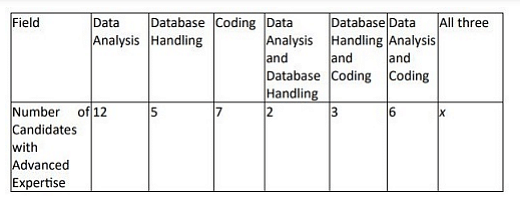
The number of applicants with advanced expertise in all three fields is given as x in the table, where x is a non-negative integer.
- XAT - 2024
- Data Interpretation