There are ten counters in the office, four dedicated to US applications, and two each for UK applications, Schengen applications and Others applications. Applicants are called in for processing sequentially on a first-come-first-served basis whenever a counter gets freed for their category. The processing time for an application is the same within each category. But it may vary across the categories. Each US and UK application requires 10 minutes of processing time. Depending on the number of applications in a category and time required to process an application for that category, it is possible that an applicant for a slot may be processed later.
On a particular day, Ira, Vijay and Nandini were scheduled for Schengen visa processing in that order. They had a 9:15 am slot but entered the VPO at 9:20 am. When they entered the office, exactly six out of the ten counters were either processing applications, or had finished processing one and ready to start processing the next.
Mahira and Osman were scheduled in the 9:30 am slot on that day for visa processing in the Others category.
The following additional information is known about that day.
1. All slots were full.
2. The number of US applications was the same in all the slots. The same was true for the other three categories.
3. 50% of the applications were US applications.
4. All applicants except Ira, Vijay and Nandini arrived on time.
5. Vijay was called to a counter at 9:25 am.
How many UK applications were scheduled on that day?
Solution and Explanation
Visa Application Processing Schedule
Applications are processed in twenty 15-minute intervals, beginning at 9:00 am and concluding at 2:00 pm. Each interval accommodates ten applications.
Total applicants: 200 (20 intervals × 10 applications per interval).
Fifty percent of applications are from the US, with an equal distribution of US applications across all intervals. This distribution pattern applies to the remaining three categories as well.
- Total US applicants: 100 (200 × 50%) → 5 per interval
- Schengen: Minimum of 3 per interval (e.g., Ira, Vijay, Nandini at 9:15 am)
- Others: Minimum of 2 per interval (e.g., Mahira and Osman at 9:30 am)
- UK: 0 per interval (inferred from constraints)
There are 10 counters allocated as follows:
- 4 for US (10 minutes per application)
- 2 for Schengen (12.5 minutes per application)
- 2 for Others (5 minutes per application)
- 2 for UK — not utilized in this scenario
Example: Vijay, the 5th in the Schengen queue, was processed at 9:25 am, indicating a Schengen processing time of 12.5 minutes.
| US (10 min) | Schengen (12.5 min) | Others (5 min) | |||||
|---|---|---|---|---|---|---|---|
| End Time | End Time | End Time | |||||
| C1 | C2 | C3 | C4 | C1 | C2 | C1 | C2 |
| 9:10 | 9:10 | 9:10 | 9:10 | 9:12:30 | 9:12:30 | 9:05 | 9:05 |
| 9:20 | 9:25 | 9:25 | 9:25 | 9:25 | 9:32:30 | 9:20 | 9:20 |
| 9:30 | 9:35 | 9:40 | 9:40 | 9:37:30 | 9:45 | 9:35 | 9:35 |
| 9:40 | 9:45 | 9:50 | 9:55 | ||||
| 9:55 | 9:55 | 10:00 | 10:05 | ||||
| 10:10 | 10:10 | 10:10 | 10:15 | ||||
| 10:20 | |||||||
On a specific day, Ira, Vijay, and Nandini were scheduled for Schengen visa processing sequentially at 9:15 am but entered the Visa Processing Office (VPO) at 9:20 am. At this juncture, 6 of the 10 counters were occupied or concluding their tasks.
This configuration left 4 counters unoccupied: 2 designated for UK and 2 for Others. As there were no UK applicants, these counters remained idle.
Consequently, total UK applicants = 0.
What is the maximum possible value of the total time (in minutes, nearest to its integer value) required to process all applications in the Others category on that day?
Solution and Explanation
Application processing occurs in twenty 15-minute intervals, from 9:00 am to 2:00 pm, with 10 applications per interval, totaling 200 applications.
US applications constitute 50% of the total (100 applications), with an equal distribution of 5 US applications per interval. This distribution pattern applies to other categories as well.
Ira, Vijay, and Nandini were scheduled consecutively for Schengen visa processing at 9:15 am. Given the consistent number of Schengen applicants per interval, each interval must accommodate at least 3 Schengen applicants.
Mahira and Osman were scheduled in the 9:30 am interval for "Others" category visa processing, indicating a minimum of 2 "Others" category applicants per interval.
With 10 applicants per interval, and accounting for 3 Schengen and 2 "Others" applicants, no UK applicants are allocated per interval.
Ten counters are available: 4 for US, and 2 each for UK, Schengen, and Others. US and UK applications each require 10 minutes for processing. Vijay, fifth in the queue, was called at 9:25 am, suggesting a Schengen application processing time of 12.5 minutes.
| US (10 min) | Schengen (12.5 min) | Others (5 min process) | |||||
| End Time | End Time | End Time | |||||
| C1 | C2 | C3 | C4 | C1 | C2 | C1 | C2 |
| 9.10 | 9.10 | 9.10 | 9.10 | 9.12.30 | 9.12.30 | 9.05 | 9.05 |
| 9.20 | 9.25 | 9.25 | 9.25 | 9.25 | 9.32.30 | 9.20 | 9.20 |
| 9.30 | 9.35 | 9.40 | 9.40 | 9.37.30 | 9.45 | 9.35 | 9.35 |
| 9.40 | 9.45 | 9.50 | 9.55 | ||||
| 9.55 | 9.55 | 10.00 | 10.05 | ||||
| 10.10 | 10.10 | 10.10 | 10.15 | ||||
| 10.20 | |||||||
Ira, Vijay, and Nandini, scheduled for Schengen visas at 9:15 am, arrived at the VPO at 9:20 am. At their arrival, 6 of the 10 counters were in use or had just concluded processing. This left 4 counters available: 2 for UK applications and 2 for "Others" applications, as US and Schengen counters were occupied.
Processing time for each "Others" category application is a maximum of 5 minutes, resulting in a total processing time of no more than 200 minutes for 40 applications (40 applications * 5 minutes/application).
Which of the following is the closest to the time when Nandini's application process got over?
- 9: 45am
- 9: 50am
- 9: 35am
- 9: 37am
The Correct Option is A
Solution and Explanation
Applications are processed in twenty 15-minute intervals from 9:00 am to 2:00 pm, with ten applications per interval, totaling 200 applications.
Fifty percent of applications are from the US, distributed equally across all intervals. This distribution applies to other categories as well.
Therefore, there are 100 US applications (200 × 50%), with 5 US applications per interval (100 ÷ 20).
Ira, Vijay, and Nandini were scheduled for Schengen visa processing sequentially at 9:15 am. As Schengen application numbers are consistent per interval, each interval must accommodate at least 3 Schengen applicants.
Mahira and Osman were scheduled for 'Others' category visa processing at 9:30 am, indicating a minimum of 2 'Others' category applicants per interval.
Given 10 applicants per interval and the aforementioned counts for Schengen and Others, no UK applicants are present in each interval.
There are 10 processing counters: 4 for US, and 2 each for UK, Schengen, and Others. US and UK applications require 10 minutes. Vijay, fifth in line, was called to a counter at 9:25 am. This suggests a Schengen application processing time of 12.5 minutes.
| US (10 min) | Schengen (12.5 min) | Others (5 min) | |||||
|---|---|---|---|---|---|---|---|
| End Time | End Time | End Time | |||||
| C1 | C2 | C3 | C4 | C1 | C2 | C1 | C2 |
| 9:10 | 9:10 | 9:10 | 9:10 | 9:12:30 | 9:12:30 | 9:05 | 9:05 |
| 9:20 | 9:25 | 9:25 | 9:25 | 9:25 | 9:32:30 | 9:20 | 9:20 |
| 9:30 | 9:35 | 9:40 | 9:40 | 9:37:30 | 9:45 | 9:35 | 9:35 |
| 9:40 | 9:45 | 9:50 | 9:55 | ||||
| 9:55 | 9:55 | 10:00 | 10:05 | ||||
| 10:10 | 10:10 | 10:10 | 10:15 | ||||
| 10:20 | |||||||
On a specific day, Ira, Vijay, and Nandini, scheduled for Schengen visas in that sequence at 9:15 am, arrived at the Visa Processing Office at 9:20 am. At their arrival, 6 out of 10 counters were actively processing or had just completed applications. This left 4 counters free: 2 for UK and 2 for Others, as US and Schengen counters were occupied or had just finished.
Nandini was sixth in the Schengen application queue. Based on the table, her processing is scheduled to conclude at 9:45 am.
Which of the following statements is false?
- The application process of Osman was completed before 9:45 am
- The application process of Mahira started after Nandini's.
- The application process of Mahira was completed before Nandini's.
- The application process of Osman was completed before Vijay's.
The Correct Option is B
Solution and Explanation
Applications are processed in 20 time slots, each 15 minutes long, from 9:00 am to 2:00 pm. Each slot accommodates 10 applications, totaling 200 applications (20 slots * 10 applications/slot).
US applications constitute 50% of the total, with an equal distribution across all slots. This equal distribution also applies to the other three categories.
- Total US applicants: 100 (200 * 50%)
- US applicants per slot: 5
Ira, Vijay, and Nandini were scheduled sequentially for Schengen visa processing in the 9:15 am slot. Given that the number of Schengen applicants is consistent per slot, a minimum of 3 Schengen applicants are processed in each slot.
Mahira and Osman were scheduled for visa processing in the 'Others' category in the 9:30 am slot, indicating at least 2 'Others' category applicants per slot.
With 10 applicants per slot and 3 Schengen and 2 'Others' applicants accounted for, there are no UK applicants scheduled in each slot.
There are a total of 10 processing counters:
- 4 for US applications (10-minute processing time)
- 2 for Schengen (12.5-minute processing time)
- 2 for Others (5-minute processing time)
- 2 for UK (unused)
Vijay, positioned 5th in the queue, was called to a counter at 9:25 am. This observation suggests an approximate processing time of 2.5 minutes per Schengen applicant.
| US (10 min) | Schengen (12.5 min) | Others (5 min) | |||||
|---|---|---|---|---|---|---|---|
| End Time | End Time | End Time | |||||
| C1 | C2 | C3 | C4 | C1 | C2 | C1 | C2 |
| 9:10 | 9:10 | 9:10 | 9:10 | 9:12:30 | 9:12:30 | 9:05 | 9:05 |
| 9:20 | 9:25 | 9:25 | 9:25 | 9:25 | 9:32:30 | 9:20 | 9:20 |
| 9:30 | 9:35 | 9:40 | 9:40 | 9:37:30 | 9:45 | 9:35 | 9:35 |
| 9:40 | 9:45 | 9:50 | 9:55 | ||||
| 9:55 | 9:55 | 10:00 | 10:05 | ||||
| 10:10 | 10:10 | 10:10 | 10:15 | ||||
| 10:20 | |||||||
On a specific day, Ira, Vijay, and Nandini were scheduled for Schengen visa processing sequentially at 9:15 am but began their entry into the VPO at 9:20 am. At that time:
- Six out of ten counters were occupied.
- Four counters were available: two for UK applications and two for 'Others' applications.
Evaluate Options:
Option A: Osman's application processing concluded before 9:45 am.
- Assuming Osman is 5th in the 'Others' queue (5 minutes per application), his processing would end by 9:35 am.
- Conclusion: Osman's processing concludes before 9:45 am. This statement is True.
Option B: Mahira's application processing commenced after Nandini's.
- Mahira's processing begins at 9:30 am.
- Nandini (6th in the Schengen queue) begins processing at 9:32:30 am.
- Conclusion: Mahira's processing begins before Nandini's. This statement is False.
Correct Answer: Option B is incorrect.
When did the application processing for all US applicants get over on that day?
- 3 : 40 pm
- 2 : 00 pm
- 2: 25 pm
- 2 : 05 pm
The Correct Option is D
Solution and Explanation
Applications are processed in twenty 15-minute intervals, from 9:00 am to 2:00 pm, with ten applications per interval.
This results in a total of 200 applications (20 intervals * 10 applications/interval).
50% of applications are from the US, distributed equally among the intervals. The same distribution applies to the other three categories.
Consequently, there are 100 US applications (200 * 50%), meaning 5 US applications per interval (100 / 20).
Ira, Vijay, and Nandini were scheduled for Schengen visa processing, in that order, at the 9:15 am interval. As Schengen applications are evenly distributed, each interval must have at least 3 Schengen applicants.
Mahira and Osman were scheduled for visa processing in the 'Others' category at the 9:30 am interval, indicating at least 2 applicants in this category per interval.
With 10 applications per interval and 3 Schengen and 2 'Others' applicants already accounted for, there are no UK applicants in each interval.
Ten counters are available: 4 for US, 2 for UK, 2 for Schengen, and 2 for 'Others'. US and UK applications each take 10 minutes. Vijay, 5th in the queue, was called to a counter at 9:25 am, implying a processing time of 12.5 minutes for Schengen applications.
| US (10 min) | Schengen (12.5 min) | Others (5 min process) | |||||
| End Time | End Time | End Time | |||||
| C1 | C2 | C3 | C4 | C1 | C2 | C1 | C2 |
| 9.10 | 9.10 | 9.10 | 9.10 | 9.12.30 | 9.12.30 | 9.05 | 9.05 |
| 9.20 | 9.25 | 9.25 | 9.25 | 9.25 | 9.32.30 | 9.20 | 9.20 |
| 9.30 | 9.35 | 9.40 | 9.40 | 9.37.30 | 9.45 | 9.35 | 9.35 |
| 9.40 | 9.45 | 9.50 | 9.55 | ||||
| 9.55 | 9.55 | 10.00 | 10.05 | ||||
| 10.10 | 10.10 | 10.10 | 10.15 | ||||
| 10.20 | |||||||
On a specific day, Ira, Vijay, and Nandini were scheduled for Schengen visa processing in that sequence at 9:15 am but arrived at the VPO at 9:20 am. Upon their arrival, 6 out of 10 counters were busy or had just finished processing and were ready for new applications. This left 4 available counters: 2 for UK and 2 for 'Others', as US and Schengen counters were occupied or had just completed processing.
Let's verify the details systematically.
The first interval requires 20 minutes to complete, while the subsequent 19 intervals each take 15 minutes for US application processing. The total processing time is calculated as follows:
- First interval: 20 minutes
- Remaining 19 intervals: 19 intervals * 15 minutes = 285 minutes
Total processing time = 20 minutes + 285 minutes = 305 minutes.
305 minutes is equivalent to 5 hours and 5 minutes.
Adding 5 hours and 5 minutes to the 9:00 am start time results in:
9:00 am + 5 hours = 2:00 pm. 2:00 pm + 5 minutes = 2:05 pm.
Therefore, the completion time is 2:05 pm.
Options Verification:
Option A: Osman's application process concluded before 9:45 am.
- It was previously determined that Osman's application process, commencing at 9:30 am and being the fifth in his category, concludes at 9:35 am.
- True: Osman's process ends before 9:45 am.
Option B: Mahira's application process commenced after Nandini's.
- Mahira's application process begins at 9:30 am.
- Nandini's application process begins at 9:32:30 am.
- False: Mahira's process begins before Nandini's.
Consequently, the correct option is indeed Option D.
Top Questions on Data Analysis
- The schematic diagram below shows 12 rectangular houses in a housing complex. House numbers are mentioned in the rectangles representing the houses. The houses are located in six columns - Column-A through Column-F, and two rows - Row-1 and Row- 2 . The houses are divided into two blocks - Block XX and Block YY. The diagram also shows two roads, one passing in front of the houses in Row-2 and another between the two blocks.

Some of the houses are occupied. The remaining ones are vacant and are the only ones available for sale.
The road adjacency value of a house is the number of its sides adjacent to a road. For example, the road adjacency values of C2, F2, and B1 are 2, 1, and 0, respectively. The neighbour count of a house is the number of sides of that house adjacent to occupied houses in the same block. For example, E1 and C1 can have the maximum possible neighbour counts of 3 and 2, respectively.
The base price of a vacant house is Rs. 10 lakhs if the house does not have a parking space, and Rs. 12 lakhs if it does. The quoted price (in lakhs of Rs.) of a vacant house is calculated as (base price) + 5 × (road adjacency value) + 3 × (neighbour count).
The following information is also known.
1. The maximum quoted price of a house in Block XX is Rs. 24 lakhs. The minimum quoted price of a house in block YY is Rs. 15 lakhs, and one such house is in Column-E.
2. Row-1 has two occupied houses, one in each block.
3. Both houses in Column-E are vacant. Each of Column-D and Column-F has at least one occupied house.
4. There is only one house with parking space in Block YY. - There are nine boxes arranged in a 3×3 array as shown in Tables 1 and 2. Each box contains three sacks. Each sack has a certain number of coins, between 1 and 9, both inclusive.
The average number of coins per sack in the boxes are all distinct integers. The total number of coins in each row is the same. The total number of
coins in each column is also the same.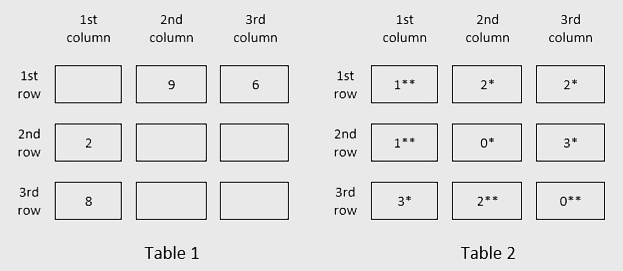
Table 1 gives information regarding the median of the numbers of coins in the three sacks in a box for some of the boxes. In Table 2 each box has a number which represents the number of sacks in that box having more than 5 coins. That number is followed by a * if the sacks in that box satisfy exactly one among the following three conditions, and it is followed by ** if two or more of these conditions are satisfied.
i) The minimum among the numbers of coins in the three sacks in the box is 1.
ii) The median of the numbers of coins in the three sacks is 1.
iii) The maximum among the numbers of coins in the three sacks in the box is 9. - There are nine boxes arranged in a 3×3 array as shown in Tables 1 and 2.

Each box contains three sacks. Each sack has a certain number of coins, between 1 and 9, both inclusive.
The average number of coins per sack in the boxes are all distinct integers. The total number of coins in each row is the same.
The total number of coins in each column is also the same. Table 1 gives information regarding the median of the numbers of coins in the three sacks in a box for some of the boxes. In Table 2 each box has a number which represents the number of sacks in that box having more than 5 coins. That number is followed by a * if the sacks in that box satisfy exactly one among the following three conditions, and it is followed by ** if two or more of these conditions are satisfied.
i) The minimum among the numbers of coins in the three sacks in the box is 1.
ii) The median of the numbers of coins in the three sacks is 1.
iii) The maximum among the numbers of coins in the three sacks in the box is 9. - Anjali, Bipasha, and Chitra visited an entertainment park that has four rides. Each ride lasts one hour and can accommodate one visitor at one point. All rides begin at 9 am and must be completed by 5 pm except for Ride-3, for which the last ride has to be completed by 1 pm. Ride gates open every 30 minutes, e.g. 10 am, 10:30 am, and so on. Whenever a ride gate opens, and there is no visitor inside, the first visitor waiting in the queue buys the ticket just before taking the ride. The ticket prices are Rs. 20, Rs. 50, Rs. 30 and Rs. 40 for Rides 1 to 4, respectively. Each of the three visitors took at least one ride and did not necessarily take all rides. None of them took the same ride more than once. The movement time from one ride to another is negligible, and a visitor leaves the ride immediately after the completion of the ride. No one takes a break inside the park unless mentioned explicitly.
The following information is also known.
1. Chitra never waited in the queue and completed her visit by 11 am after spending Rs. 50 to pay for the ticket(s).
2. Anjali took Ride-1 at 11 am after waiting for 30 mins for Chitra to complete it. It was the only ride where Anjali waited.
3. Bipasha began her first of three rides at 11:30 am. All three visitors incurred the same amount of ticket expense by 12:15 pm.
4. The last ride taken by Anjali and Bipasha was the same, where Bipasha waited 30 mins for Anjali to complete her ride. Before standing in the queue for that ride, Bipasha took a 1- hour coffee break after completing her previous ride - Want to practice more? Try solving extra ecology questions todayView All Questions