Question:hard
A particle of mass \(2.2\times 10^{-30}\,\text{kg}\) and charge \(1.6\times 10^{-19}\,\text{C}\) is moving at a speed of \(10\,\text{km s}^{-1}\) in a circular path of radius \(2.8\,\text{cm}\) inside a solenoid. The solenoid has \(25\,\text{turns/cm}\) and its magnetic field is perpendicular to the plane of the particle's path. The current in the solenoid is
Take \(\mu_0=4\pi\times 10^{-7}\,\text{H m}^{-1}\).
A particle of mass \(2.2\times 10^{-30}\,\text{kg}\) and charge \(1.6\times 10^{-19}\,\text{C}\) is moving at a speed of \(10\,\text{km s}^{-1}\) in a circular path of radius \(2.8\,\text{cm}\) inside a solenoid. The solenoid has \(25\,\text{turns/cm}\) and its magnetic field is perpendicular to the plane of the particle's path. The current in the solenoid is
Take \(\mu_0=4\pi\times 10^{-7}\,\text{H m}^{-1}\).
Take \(\mu_0=4\pi\times 10^{-7}\,\text{H m}^{-1}\).
Show Hint
For a charged particle moving in a circular path in a magnetic field, use
\[
qvB=\frac{mv^2}{r}
\]
and for a solenoid, use
\[
B=\mu_0 nI
\]
where \(n\) must be in turns per metre.
Updated On: Jun 22, 2026
- \(1.25\,\text{mA}\)
- \(10.20\,\text{mA}\)
- \(2.50\,\text{mA}\)
- \(1.56\,\text{mA}\)
Show Solution
The Correct Option is D
Solution and Explanation
Step 1: Use the condition for circular motion of the charged particle.
The magnetic force provides centripetal force inside the solenoid: \[ qvB = \frac{mv^2}{r} \implies B = \frac{mv}{qr} \]
Step 2: Convert all quantities to SI units.
$m = 2.2 \times 10^{-30}\,\text{kg}$, $q = 1.6 \times 10^{-19}\,\text{C}$, $v = 10\,\text{km/s} = 10^4\,\text{m/s}$, $r = 2.8\,\text{cm} = 2.8 \times 10^{-2}\,\text{m}$.
Step 3: Calculate the magnetic field inside the solenoid.
\[ B = \frac{mv}{qr} = \frac{2.2 \times 10^{-30} \times 10^4}{1.6 \times 10^{-19} \times 2.8 \times 10^{-2}} \] \[ B = \frac{2.2 \times 10^{-26}}{4.48 \times 10^{-21}} = \frac{2.2}{4.48} \times 10^{-5} \approx 4.91 \times 10^{-6}\,\text{T} \]
Step 4: Apply Ampere's circuital law for a solenoid.
The magnetic field inside a solenoid is: \[ B = \mu_0 n I \] where $n$ is the number of turns per unit length and $I$ is the current. Given $n = 25\,\text{turns/cm} = 2500\,\text{turns/m}$ and $\mu_0 = 4\pi \times 10^{-7}\,\text{H/m}$.
Step 5: Solve for the current $I$.
\[ I = \frac{B}{\mu_0 n} = \frac{4.91 \times 10^{-6}}{4\pi \times 10^{-7} \times 2500} \] \[ I = \frac{4.91 \times 10^{-6}}{\pi \times 10^{-3}} = \frac{4.91}{\pi} \times 10^{-3}\,\text{A} \approx 1.56\,\text{mA} \]
Step 6: State the final answer.
The current in the solenoid required to maintain the circular orbit is: \[ \boxed{I \approx 1.56\,\text{mA}} \]
The magnetic force provides centripetal force inside the solenoid: \[ qvB = \frac{mv^2}{r} \implies B = \frac{mv}{qr} \]
Step 2: Convert all quantities to SI units.
$m = 2.2 \times 10^{-30}\,\text{kg}$, $q = 1.6 \times 10^{-19}\,\text{C}$, $v = 10\,\text{km/s} = 10^4\,\text{m/s}$, $r = 2.8\,\text{cm} = 2.8 \times 10^{-2}\,\text{m}$.
Step 3: Calculate the magnetic field inside the solenoid.
\[ B = \frac{mv}{qr} = \frac{2.2 \times 10^{-30} \times 10^4}{1.6 \times 10^{-19} \times 2.8 \times 10^{-2}} \] \[ B = \frac{2.2 \times 10^{-26}}{4.48 \times 10^{-21}} = \frac{2.2}{4.48} \times 10^{-5} \approx 4.91 \times 10^{-6}\,\text{T} \]
Step 4: Apply Ampere's circuital law for a solenoid.
The magnetic field inside a solenoid is: \[ B = \mu_0 n I \] where $n$ is the number of turns per unit length and $I$ is the current. Given $n = 25\,\text{turns/cm} = 2500\,\text{turns/m}$ and $\mu_0 = 4\pi \times 10^{-7}\,\text{H/m}$.
Step 5: Solve for the current $I$.
\[ I = \frac{B}{\mu_0 n} = \frac{4.91 \times 10^{-6}}{4\pi \times 10^{-7} \times 2500} \] \[ I = \frac{4.91 \times 10^{-6}}{\pi \times 10^{-3}} = \frac{4.91}{\pi} \times 10^{-3}\,\text{A} \approx 1.56\,\text{mA} \]
Step 6: State the final answer.
The current in the solenoid required to maintain the circular orbit is: \[ \boxed{I \approx 1.56\,\text{mA}} \]
Was this answer helpful?
0
Top Questions on Amperes circuital law
- A coil has a resistance of \( 30 \, \Omega \) and an inductive reactance of \( 20 \, \Omega \) at 50 Hz frequency. If an AC source of 200 V and 100 Hz is connected across the coil, then how much current will flow through the coil?
- MHT CET - 2024
- Physics
- Amperes circuital law
- In a series LCR circuit connected to an AC source, at resonance, the current is maximum because:
- MHT CET - 2024
- Physics
- Amperes circuital law
Consider the circuit shown :
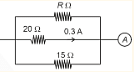 The ammeter reads 0.9 A. Value of R is
- JEE Main - 2024
- Physics
- Amperes circuital law
- A transistor is used in an amplifier circuit in common emitter mode. If the base current changes by 100μA, it brings a change of 10mA in collector current. If the load resistance is 2kΩ and input resistance is 1kΩ, the value of power gain is \(x×10^4\). The value of x is _______.
- JEE Main - 2022
- Physics
- Amperes circuital law
- Want to practice more? Try solving extra ecology questions todayView All Questions