Question:medium
A clock is set right at 10 am.The clock gains 10 minutes in a day.What will be the true time when the watch indicates 3 pm the next day?
A clock is set right at 10 am.The clock gains 10 minutes in a day.What will be the true time when the watch indicates 3 pm the next day?
Updated On: Jan 13, 2026
- 12 minutes past 2 pm
- 45 minutes past 2 pm
- 32 minutes past 2 pm
- 48 minutes past 2 pm
Show Solution
The Correct Option is D
Solution and Explanation
The clock advances by 10 minutes every 24 hours. Over a period of 24 hours, the clock will be 10 minutes ahead of the actual time. The observation period spans 1 day and 5 hours (from 10 am to 3 pm the following day), so the total elapsed time is:
\ \[\ 24 \, \text{hours} + 5 \, \text{hours} = 29 \, \text{hours}.\ \]\
Given the clock gains 10 minutes every 24 hours, over 29 hours it will gain:
\ \[\ \frac{10 \times 29}{24} = 12.08 \, \text{minutes}.\ \]\
Therefore, when the watch indicates 3 pm, the actual time is:
\ \[\ 3 : 00 - 12.08 \, \text{minutes} = 2 : 47 : 52 \, \text{pm}.\ \]\
In conclusion, the true time is roughly 48 minutes past 2 pm.
Was this answer helpful?
0
Top Questions on Clock and Calendar
- If it was a Friday on 1 January 2016, what was the day of the week on 31 December 2016?
- VITEEE - 2024
- General Aptitude
- Clock and Calendar
- When the time is 8:30, the angle between the minute hand and the hour hand of a clock is:
- VITEEE - 2025
- Aptitude
- Clock and Calendar
- How many times does the 29th day of the month occur in 800 successive years?
- IBSAT
- Quantitative Aptitude
- Clock and Calendar
- Five bells begin to toll together and toll respectively at intervals of 6,7,8,9 and 12 seconds. How many times, will they toll together in one hour excluding the one at the start?
- IBSAT
- Quantitative Aptitude
- Clock and Calendar
- Want to practice more? Try solving extra ecology questions todayView All Questions
Questions Asked in CMAT exam
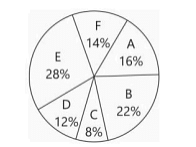
Study the pie chart and table and answer the questions
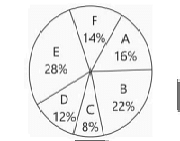
What is the difference between average number of linen kurtis sold by stores D and E together and average number of cotton kurtis sold by the same stores together?
| Store | Respective ratio of number of linen kurtis to cotton kurtis sold |
| A | 7:5 |
| B | 5:6 |
| C | 3:2 |
| D | 5:3 |
| E | 4:3 |
| F | 7:3 |
What is the difference between average number of linen kurtis sold by stores D and E together and average number of cotton kurtis sold by the same stores together?
- CMAT - 2024
- Pie Charts