Question:medium
A capacitor of capacitance C=900 pF is charged rally by 100 V battery B as shown in figure (a). Then B is disconnected from the battery and connected to another uncharged capacitor of capacitance C=900 pF as shown in figure (b). The electrostatic energy stored by the system (b)is:

A capacitor of capacitance C=900 pF is charged rally by 100 V battery B as shown in figure (a). Then B is disconnected from the battery and connected to another uncharged capacitor of capacitance C=900 pF as shown in figure (b). The electrostatic energy stored by the system (b)is:
Updated On: May 1, 2026
- \(4.5 \times 10^{-6} J\)
- \(3.25 \times 10^{-6} J\)
- \(2.25 \times 10^{-6} J\)
- \(1.5 \times 10^{-6} J\)
Show Solution
The Correct Option is C
Solution and Explanation
Step 1: Understanding the Concept:
When a charged capacitor is connected to an uncharged one, the total charge is conserved but distributed across both.
Due to this redistribution, some energy is lost (mainly as heat and radiation), and the final energy is less than the initial energy.
Key Formula or Approach:
1. Initial Energy: \(U_i = \frac{1}{2}CV^2\)
2. Common Potential: \(V_c = \frac{C_1V_1 + C_2V_2}{C_1 + C_2}\)
3. Final Energy: \(U_f = \frac{1}{2}(C_1 + C_2)V_c^2\)
Step 2: Detailed Explanation:
1. Initial Energy calculation:
\(C = 900 \text{ pF} = 900 \times 10^{-12} \text{ F}\), \(V = 100 \text{ V}\).
\[ U_i = \frac{1}{2} \times 900 \times 10^{-12} \times (100)^2 = 450 \times 10^{-12} \times 10^4 = 4.5 \times 10^{-6} \text{ J} \]
2. Common Potential calculation:
Since \(C_1 = C_2 = 900 \text{ pF}\) and the second is uncharged:
\[ V_c = \frac{C \times 100 + C \times 0}{C + C} = \frac{100C}{2C} = 50 \text{ V} \]
3. Final Energy of system (b):
The total capacitance is \(C_{total} = C + C = 1800 \text{ pF}\).
\[ U_f = \frac{1}{2} \times (1800 \times 10^{-12}) \times (50)^2 \]
\[ U_f = 900 \times 10^{-12} \times 2500 = 225 \times 10^4 \times 10^{-12} = 2.25 \times 10^{-6} \text{ J} \]
Step 3: Final Answer:
The energy stored by the system is \(2.25 \times 10^{-6}\) J.
When a charged capacitor is connected to an uncharged one, the total charge is conserved but distributed across both.
Due to this redistribution, some energy is lost (mainly as heat and radiation), and the final energy is less than the initial energy.
Key Formula or Approach:
1. Initial Energy: \(U_i = \frac{1}{2}CV^2\)
2. Common Potential: \(V_c = \frac{C_1V_1 + C_2V_2}{C_1 + C_2}\)
3. Final Energy: \(U_f = \frac{1}{2}(C_1 + C_2)V_c^2\)
Step 2: Detailed Explanation:
1. Initial Energy calculation:
\(C = 900 \text{ pF} = 900 \times 10^{-12} \text{ F}\), \(V = 100 \text{ V}\).
\[ U_i = \frac{1}{2} \times 900 \times 10^{-12} \times (100)^2 = 450 \times 10^{-12} \times 10^4 = 4.5 \times 10^{-6} \text{ J} \]
2. Common Potential calculation:
Since \(C_1 = C_2 = 900 \text{ pF}\) and the second is uncharged:
\[ V_c = \frac{C \times 100 + C \times 0}{C + C} = \frac{100C}{2C} = 50 \text{ V} \]
3. Final Energy of system (b):
The total capacitance is \(C_{total} = C + C = 1800 \text{ pF}\).
\[ U_f = \frac{1}{2} \times (1800 \times 10^{-12}) \times (50)^2 \]
\[ U_f = 900 \times 10^{-12} \times 2500 = 225 \times 10^4 \times 10^{-12} = 2.25 \times 10^{-6} \text{ J} \]
Step 3: Final Answer:
The energy stored by the system is \(2.25 \times 10^{-6}\) J.
Was this answer helpful?
0
Top Questions on Electric Potential And Potential Difference
- How is a voltmeter connected in the circuit to measure the potential difference between two points?
- CBSE Class X
- Science
- Electric Potential And Potential Difference
- A thin spherical shell is charged by some source. The potential difference between the two points C and P (in V) shown in the figure is:
(Take \(\frac{1}{4}\pi\epsilon_0 = 9 × 10⁹\)\(\frac{1}{4\pi\epsilon_0}=9\times10^9\) SI units)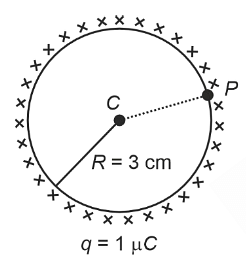
- NEET (UG) - 2024
- Physics
- Electric Potential And Potential Difference
- A charge of 10 coulomb is brought from infinity to a point \( P \) near a charged body and in this process 200 joules of work is done. Electric potential at point \( P \) is:
- JEECUP - 2024
- Physics
- Electric Potential And Potential Difference
Resistance of each side is $R$. Find equivalent resistance between two opposite points as shown in the figure.

- JEE Main - 2026
- Physics
- Electric Potential And Potential Difference
- Want to practice more? Try solving extra ecology questions todayView All Questions

