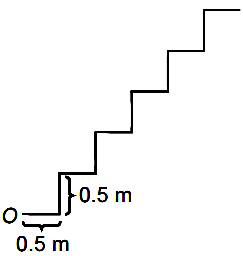
Consider a series of steps as shown. A ball is thrown from 0. Find the minimum speed to directly jump to 5th step
A body of mass 1000 kg is moving horizontally with a velocity of 6 m/s. If 200 kg extra mass is added, the final velocity (in m/s) is:
The drift velocity of electrons for a conductor connected in an electrical circuit is $V _{ d }$ The conductor in now replaced by another conductor with same material and same length but double the area of cross section The applied voltage remains same The new drift velocity of electrons will be
A body is moving with constant speed, in a circle of radius $10 m$ .The body completes one revolution in 4 s .At the end of 3 rd second, the displacement of body (in mi) from its starting point is :
The velocity-time graph of a body moving in a straight line is shown in the figure.The ratio of displacement to distance travelled by the body in time 0 to 10s is:
An object of mass 'm' initially at rest on a smooth horizontal plane starts moving under the action of force $F=2 N$ In the process of its linear motion, the angle $\theta$ (as shown in figure) between the direction of force and horizontal varies as $\theta=k x$, where $k$ is a constant and $x$ is the distance covered by the object from its initial position The expression of kinetic energy of the object will be $E=\frac{n}{k} \sin \theta$ The valte of $n$ is