Question:easy
Which of the following plant produces non-albuminous seeds ?
Which of the following plant produces non-albuminous seeds ?
Show Hint
• As a general rule of thumb, most dicots produce non-albuminous seeds (exception: Castor is a dicot but produces albuminous seeds).
• Most monocots produce albuminous seeds (exception: Orchids are monocots but produce non-albuminous seeds).
• In some seeds, such as black pepper and beet, remnants of the nucellus also persist; this residual, persistent nucellus is called perisperm.
• Most monocots produce albuminous seeds (exception: Orchids are monocots but produce non-albuminous seeds).
• In some seeds, such as black pepper and beet, remnants of the nucellus also persist; this residual, persistent nucellus is called perisperm.
Updated On: Jun 21, 2026
- Pea
- Wheat
- Maize
- Barley
Show Solution
The Correct Option is A
Solution and Explanation
Step 1: Recall the two seed types.
Seeds are either non-albuminous (no endosperm left at maturity) or albuminous (endosperm persists as a food store).
Step 2: Understand non-albuminous seeds.
In these, the developing embryo eats up all the endosperm and stores the food in fleshy cotyledons instead. Examples are pea, gram, groundnut and beans.
Step 3: Understand albuminous seeds.
Here the endosperm is not fully used up and remains in the mature seed. Examples are wheat, maize, barley and castor.
Step 4: Examine pea.
Pea is a dicot whose embryo absorbs all the endosperm, so the mature seed is non-albuminous.
Step 5: Examine wheat, maize and barley.
These are cereal monocots that keep a large endosperm in the mature seed, making them albuminous.
Step 6: Conclude.
Only pea produces non-albuminous seeds among the choices.
\[ \boxed{\text{Pea}} \]
Seeds are either non-albuminous (no endosperm left at maturity) or albuminous (endosperm persists as a food store).
Step 2: Understand non-albuminous seeds.
In these, the developing embryo eats up all the endosperm and stores the food in fleshy cotyledons instead. Examples are pea, gram, groundnut and beans.
Step 3: Understand albuminous seeds.
Here the endosperm is not fully used up and remains in the mature seed. Examples are wheat, maize, barley and castor.
Step 4: Examine pea.
Pea is a dicot whose embryo absorbs all the endosperm, so the mature seed is non-albuminous.
Step 5: Examine wheat, maize and barley.
These are cereal monocots that keep a large endosperm in the mature seed, making them albuminous.
Step 6: Conclude.
Only pea produces non-albuminous seeds among the choices.
\[ \boxed{\text{Pea}} \]
Was this answer helpful?
0
Top Questions on The Seed
Identify the part of the seed from the given figure which is destined to form root when the seed germinates.
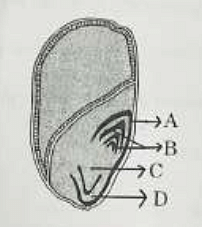
- NEET (UG) - 2024
- Biology
- The Seed
- In the seeds of cereals, the outer covering of endosperm separates the embryo by a protein-rich layer called:
- NEET (UG) - 2025
- Biology
- The Seed
- Draw the labelled diagram of the following:
(i) gram seed
(ii) V.S. of maize seed- CBSE Class XI
- Biology
- The Seed
- Non-albuminous seed is produced in:
- NEET (UG) - 2014
- Biology
- The Seed
- Want to practice more? Try solving extra ecology questions todayView All Questions

